



Road Accidents in AJK: 658 Lives Lost in 4 Years, how many more?

Road Accidents in AJK – Four schoolchildren, including three brothers, were travelling to school when their journey ended in tragedy. A day later, another seven people died when a passenger jeep plunged into a deep ravine, including a father and his two sons.
The two accidents, reported on 24 and 25 October, claimed 11 lives in Azad Jammu and Kashmir, raising a critical question: how safe are the roads that thousands of people depend on every day?
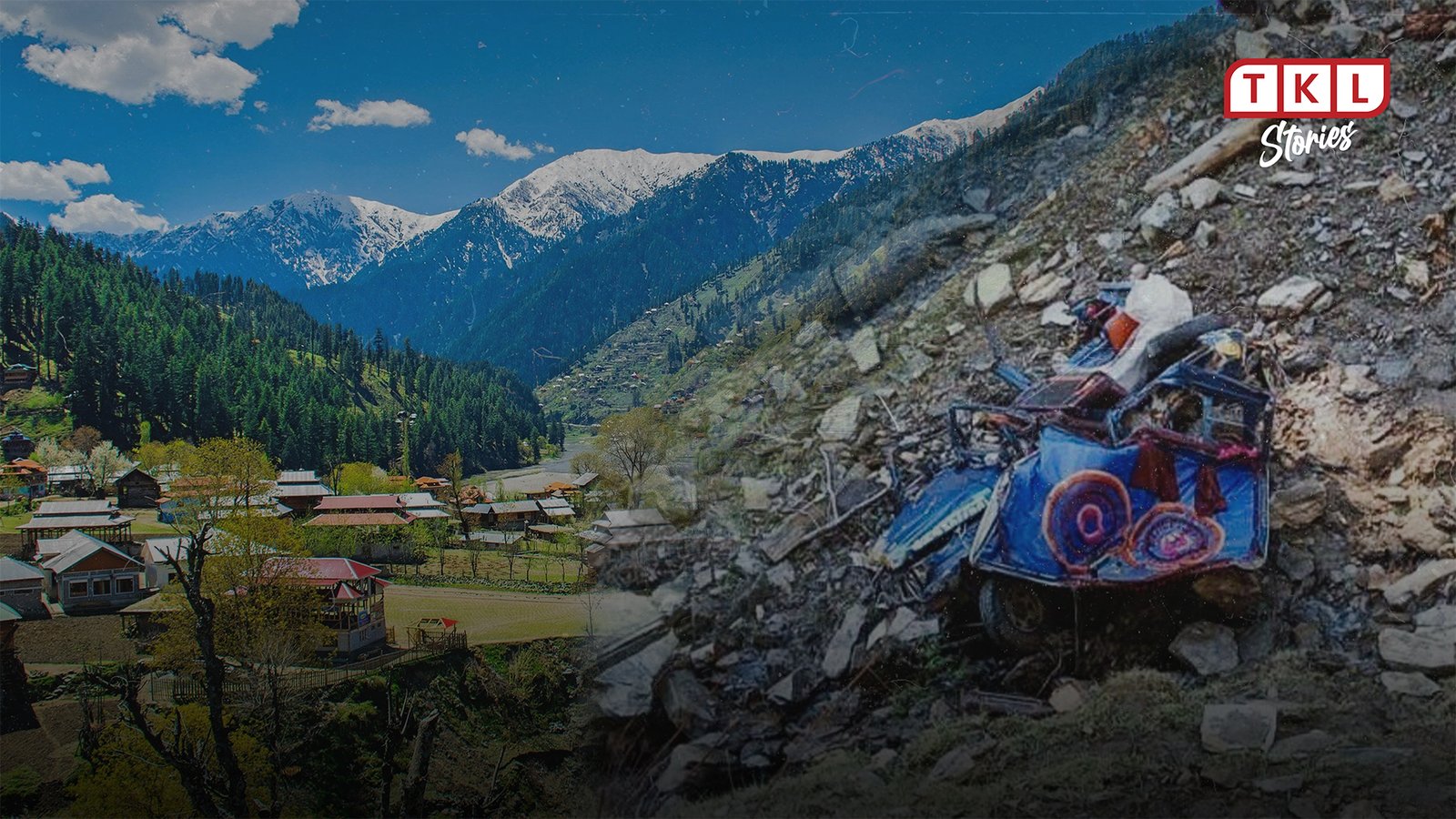
On the morning of 24 October, a father left his home in Nagdar, Neelum Valley, to drop his children off at school. Near Ghora Nikah Bend on the Keran Bypass link road, the vehicle went out of control while negotiating a sharp turn and plunged off the road.
Four children from the same family, including three biological brothers, died in the accident, while several other people were injured and taken to hospital.
Reports differed on whether the vehicle fell into the Neelum River or into a deep ravine near the river.
The following day, a passenger jeep travelling from Nakka Shakar Patiyan towards Seri Dara plunged down a steep slope near Sathra Podimar. All seven people aboard died.
Among the victims were 50-year-old Fayyaz Ahmed and his two adult sons.
According to police and administrative authorities, the vehicle had travelled approximately three kilometres from Shakar Patiyan before the accident. It reportedly fell between 1,000 and 1,500 feet below the road, making the recovery operation difficult.
Local residents and rescue workers recovered the bodies, which were subsequently handed over to the bereaved families.
The two incidents left several families mourning loved ones who had set out on ordinary journeys but never returned home.
Road Accidents in AJK – Four Fatal Accidents in October
The two tragedies were not the only fatal road accidents reported in Azad Kashmir during October.
On 12 October, a school van met with an accident in Jhala, in Dhirkot Tehsil of Bagh District. One woman died and 16 children were injured.
On 16 October, a car carrying a couple who had travelled from Rawalpindi for tourism plunged into a deep ravine at Bam Kot, Pangirang, in the Muzaffarabad area. The woman died at the scene, while her husband sustained serious injuries.
Together, these four reported accidents claimed at least 13 lives during October, according to the figures provided in the incident reports.
The incidents involved school transport, private travel and a passenger jeep, highlighting the range of road users exposed to the risks associated with travelling through the region.
However, the circumstances of each accident would need to be established through official investigations before responsibility or specific causes could be determined.
Road Accidents in AJK – What Do the Statistics Reveal?
Figures published in the Azad Jammu and Kashmir Statistical Yearbook 2025 provide a broader picture of road safety in the region.
Between 2021 and 2024, a total of 1,509 road traffic accidents were reported in Azad Kashmir, resulting in 658 deaths and 2,743 injuries.
The year-by-year figures show that 372 accidents were reported in 2021, causing 193 deaths and 650 injuries.
In 2022, 361 accidents resulted in 135 deaths and 563 injuries. The number of reported accidents increased to 381 in 2023, when 144 people died and 790 were injured.
In 2024, the region recorded 395 accidents, resulting in 186 deaths and 740 injuries.
The annual number of reported accidents generally increased over the four-year period, with 2024 recording the highest number of accidents among those years.
The figures underline the scale of the challenge facing road users and authorities. However, they do not, on their own, establish the causes of individual accidents or determine how many could have been prevented through specific interventions.
Why Are AJK’s Mountain Roads So Dangerous?
Azad Kashmir’s mountainous terrain presents significant challenges for drivers and passengers.
Many roads pass along steep slopes, negotiate sharp bends and run beside deep ravines. Narrow stretches, deteriorating road surfaces and inadequate safety barriers or warning signs can increase the risks in some locations.
Landslides and adverse weather conditions can create additional hazards, particularly on routes through mountainous districts.
The Human Rights Commission of Pakistan’s 2024 report also highlighted concerns about poor road conditions, narrow routes and inadequate safety measures in some rural and mountainous areas of Azad Kashmir.
Vehicle roadworthiness, passenger overloading, driver training and enforcement of traffic regulations are other factors that warrant attention when assessing road safety.
Nevertheless, difficult terrain alone does not explain every accident. Establishing the contribution of road design, vehicle condition, driver behaviour, weather and other factors requires reliable accident investigations and systematic data collection.
That evidence is essential if authorities are to identify high-risk locations and determine which interventions would be most effective.
Road Accidents in AJK – What Needs to Change?
The recent accidents have renewed questions about the adequacy of road safety measures across Azad Kashmir, particularly on routes where a vehicle leaving the road can result in a fatal fall.
Installing strong safety barriers at dangerous bends, improving warning signs, repairing damaged road surfaces and identifying sections requiring urgent safety improvements could help reduce risks.
Authorities could also prioritise regular inspections of passenger vehicles, enforcement of passenger capacity limits and appropriate driver training, particularly for those operating on steep and winding mountain routes.
Landslide-prone areas require continued monitoring, while road safety assessments could help identify locations where protective barriers, improved drainage or changes to road design are needed.
Transparent investigations into fatal accidents would also help establish their causes and identify lessons for preventing similar incidents.
For school transport, vehicle inspections, compliance with passenger limits and appropriate safety procedures are especially important because children depend on others to ensure their journeys are safe.
These measures require coordination between road authorities, traffic police, transport operators and local administrations. They also require sustained investment, rather than action limited to the aftermath of a major accident.
A Question of Prevention
When a road accident occurs, rescue workers and local residents often face the immediate challenge of reaching victims in difficult terrain. In areas with deep ravines and limited access, recovery operations can be particularly demanding.
But the response after a crash is only one part of road safety.
The more fundamental question is whether authorities are doing enough to identify dangerous roads, improve infrastructure, enforce safety regulations and prevent accidents before they happen.
The deaths of four schoolchildren in Neelum Valley, followed a day later by the deaths of seven passengers near Muzaffarabad, have brought that question into sharp focus.
Behind the statistics are families whose lives have changed permanently. Three brothers will not return home from school. A father and his two sons will not return to their family.
Between 2021 and 2024, road accidents in Azad Kashmir claimed 658 lives, according to the regional statistical yearbook. The figures demand more than expressions of grief after every tragedy. They call for evidence-based action to make the region’s roads safer.
For the families who have lost loved ones, no road repair or safety barrier can reverse what has happened. But identifying hazards, addressing preventable risks and holding institutions accountable for their responsibilities could help spare other families the same pain.
The question is no longer simply why accidents happen on Azad Kashmir’s roads. It is what authorities can do now to prevent the next tragedy.


