




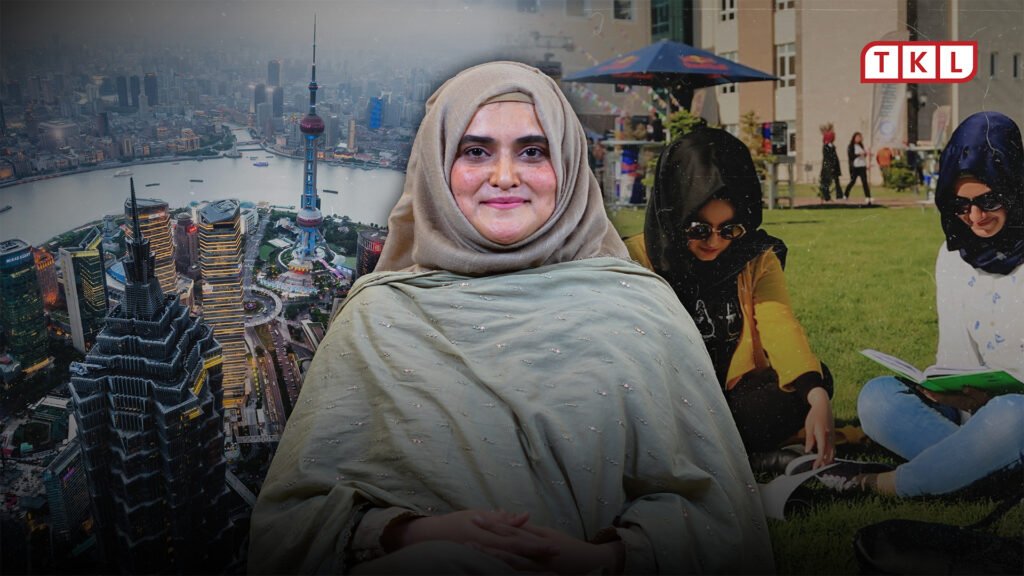
A scholarship to China became a transformative experience for Esha Iqbal, a Pakistani education professional from Bhimber, Azad Jammu and Kashmir, broadening her understanding of women’s empowerment, cultural diversity and the importance of international exposure.
Currently serving as Deputy Director of the Open and Distance Learning (ODL) Office at Bahria University, Islamabad, Iqbal has more than a decade of experience in learning and development, having worked with corporate organisations, non-governmental organisations and the education sector.
She completed her bachelor’s degree at the National University of Sciences and Technology (NUST) before moving to China in September 2019 to pursue a master’s degree in Women Leadership and Social Development.
The two-year programme, which she described as equivalent to an MPhil qualification, was part of an initiative aimed at supporting women’s development in developing countries. Iqbal was selected for the opportunity based on her previous experience in women’s development and training.
In an interview with TKL Stories, she said studying abroad significantly changed her professional and personal outlook, particularly through rigorous academic work, research and interaction with women from different cultural backgrounds.
“Your horizons change significantly, your network expands, and your perspective towards life and professional life also changes,” she said.
Exposure and Empowerment
For Iqbal, one of the most important lessons from her experience in China was that empowerment is not limited to financial independence or professional opportunities. It also involves the ability to consider different perspectives and make informed choices.
She explained that interacting with women from Africa, the Middle East, Central America, South America and Asia exposed her to different lifestyles, customs and approaches to decision-making.
She believes such experiences help women move beyond the limitations of their immediate social and cultural environments.
“Empowerment means knowing that, in a particular situation, I can solve a problem in one way, but I can also solve it in another way. There are two possible approaches. That is empowerment because now I have a choice,” she said.
She also highlighted international networking as another important aspect of women’s empowerment, describing professional connections across countries as a valuable source of support and opportunity.
Lessons from China’s education system
Reflecting on her academic experience, Iqbal pointed to differences between university environments in China and Pakistan, particularly in time management, academic discipline, research and physical fitness.
She recalled that classes at her Chinese university began as early as 7am and continued until 9pm or later. Students were expected to maintain strict schedules, while physical activity was also incorporated into university life.
At her university, female students were required to run a specified distance every day, with GPA points awarded for completing the activity.
She contrasted this with what she described as a lack of similar emphasis on physical fitness and academic discipline in Pakistani universities.
Iqbal also discussed women’s participation in China’s workforce, explaining that she observed a working environment where women were expected to participate alongside men.
She linked this approach to the historical emphasis on women’s contribution to national development, particularly the principle associated with China that “Women Hold Up Half the Sky.”
A Pakistani Muslim woman in China
Before travelling to China, Iqbal had concerns about women’s safety, wearing a headscarf and finding halal food.
However, she said her personal experience was different from some of the expectations she had formed beforehand.
She recalled feeling comfortable moving around independently and said she did not face difficulties wearing her scarf or finding halal food during her stay.
She also shared an experience from Hohhot, where she crossed the road at around 3am to visit a mosque for prayers.
For her, the experience demonstrated the importance of feeling secure and being able to move freely in a foreign country.
She emphasised that young Pakistani women should not allow assumptions and fears to prevent them from exploring international educational opportunities.
An Ambassador for Pakistan
Iqbal believes that studying abroad also brings a responsibility to represent one’s country.
“When you go abroad, you become a representative of your country. When I am in China, I am no longer just Isha Iqbal; I am a Pakistani,” she said.
She recalled visiting Jiande, a county in Zhejiang province, as part of a community work programme. On the final day, their English translator told her that his perception of Pakistan had changed after meeting her.
He explained that whenever he heard news about Pakistan in the future, he would remember the Pakistani woman he had met and her personality.
For Iqbal, this experience demonstrated how people-to-people interactions can give countries a personal identity beyond political and diplomatic relationships.
She also discussed the term “Batie”, meaning “Iron Brothers”, which Chinese people use to refer to Pakistanis as an expression of the two countries’ longstanding friendship.
Why she chose to return to Pakistan
Despite the opportunities available abroad, Iqbal decided to return to Pakistan after completing her studies.
She said her decision was driven by a desire to serve the country that had nurtured her.
Acknowledging the frustrations and challenges of working in Pakistan, she argued that meaningful change requires individuals to contribute through professional commitment, honesty and the skills they acquire.
She encouraged university students and young professionals to recognise their value and develop practical skills that can help address the country’s needs.
“If you have the skills, does Pakistan not need talent?” she asked, emphasising that capable professionals can create opportunities by demonstrating their ability to deliver results.
Exploring Chinese Scholarships
Iqbal strongly encouraged Pakistani students, particularly young women, to explore educational and exchange opportunities in China.
She recommended looking into Chinese Government Scholarships and scholarship programmes offered directly by universities, as well as contacting professors and Pakistani students already studying there for guidance.
She also emphasised that applying for international opportunities is itself a valuable learning experience, even if an applicant is not ultimately selected.
Discussing the future of Pakistan-China relations, she said that while the two countries have strong government-level and strategic ties, greater people-to-people interaction is needed to strengthen their relationship.
She believes increasing educational and cultural exchanges will help young Pakistanis understand China better while allowing them to represent their country internationally.
“The more young people from Pakistan who go there, the better they will be able to represent their country,” she said.
For Iqbal, international education is not simply about obtaining a foreign qualification. It is about developing confidence, broadening perspectives, building networks and bringing valuable experiences back home.


