




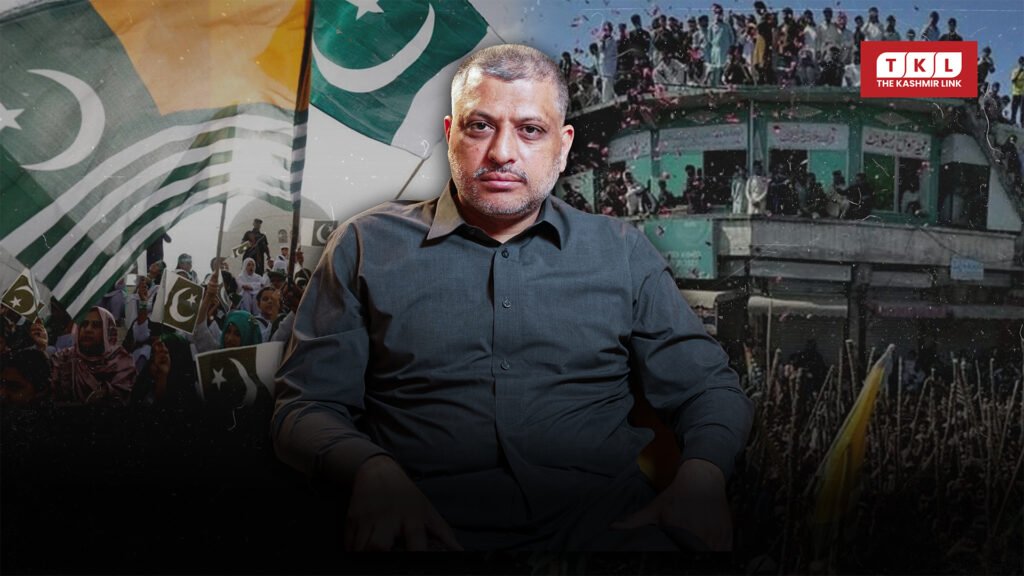
Refugee Representation – On a quiet afternoon in Islamabad, far from the mountains that define Azad Jammu and Kashmir (AJK), Ahmad Raza Qadri leans forward to make a point he believes is widely misunderstood.
“This is not just a local government,” he says. “It represents an entire state.”
It is a claim that goes to the heart of a long-running and increasingly heated debate: what exactly is Azad Kashmir, and who has the right to speak for it?
A State That Exists Beyond Its Borders
To understand the present, Qadri insists, one must return to October 1947, when a government was proclaimed in the name of the wider State of Jammu and Kashmir.
Today’s AJK administers only a fraction of that historic territory. Yet its official title—the Azad Government of the State of Jammu and Kashmir—still reflects a broader claim: that it speaks, at least symbolically, for all Kashmiris.
That idea, however, is under strain.
The Refugee Seats at the Centre of the Debate
At the core of the controversy are 12 seats in the AJK Legislative Assembly, reserved for Kashmiris who migrated to Pakistan during successive conflicts.
For critics, these seats represent an imbalance—voters who do not reside within AJK influencing its political direction.
For Qadri, who himself represents one of these constituencies, the argument misses a deeper reality.
“These are not outsiders,” he says. “They are part of the same state—people who left their homes but not their identity.”
He frames their inclusion not as a political concession, but as a continuation of the state’s original logic: that AJK exists because the broader Kashmir dispute remains unresolved.
A Shared Past, A Divided Narrative
In the early years after 1947, migrants were not peripheral figures—they were central to governance. Historical records show that many of the first officeholders in the fledgling administration had themselves migrated from areas now under Indian control.
Over time, as institutions evolved and electoral systems expanded, that shared political space remained intact.
But narratives, Qadri argues, have changed.
What began as public frustration over everyday issues—rising prices, electricity shortages, infrastructure challenges—has, in his view, transformed into something more targeted.
“A narrative has been built,” he says, “that all problems stem from these 12 seats.”
The Power of Repetition
In an age of social media, repetition can shape reality.
Qadri suggests that a one-sided discourse—amplified online and rarely challenged—has made this idea increasingly mainstream. He points to a reluctance among more measured voices to engage publicly, wary of backlash.
The result, he believes, is a debate where emotion often overtakes constitutional nuance.
A Legal Question with Political Consequences
Beneath the rhetoric lies a more complex legal dilemma.
If AJK claims to represent the entire former princely state, can it exclude a segment of that population—particularly those displaced by conflict?
And if it does, what happens to its broader claim?
“It raises a fundamental question,” Qadri says. “Are we speaking about the future of a whole state—or just a small territory?”
For him, the answer has implications beyond internal politics. It touches on the very basis on which the Kashmir issue is presented internationally.
The Economics of a Dispute
There is also a quieter, but no less significant, dimension: economics.
AJK benefits from substantial financial support, including subsidised essentials and public services—arrangements often justified within the framework of the wider Kashmir issue.
Qadri warns that altering the political structure without considering these linkages could have unintended consequences.
“These benefits,” he argues, “are not accidental. They are tied to a larger context.”
Between Emotion and Institution
As the debate grows louder, so too does the risk of polarisation.
Qadri’s concern is less about disagreement and more about the method through which change is pursued. In a parliamentary system, he notes, constitutional amendments require consensus—not street pressure.
“If decisions move from institutions to the streets,” he says, “then every decision will.”
An Unresolved Future
The question of representation in Azad Kashmir is, ultimately, a reflection of a larger uncertainty—one that has defined the region for decades.
Who belongs? Who decides? And what does representation mean in a place that claims to speak for people beyond its borders?
For now, there are no easy answers.
But as voices on all sides grow more assertive, one thing is clear: the debate is no longer confined to assembly halls—it is unfolding in the public sphere, shaping how a new generation understands Kashmir, identity and the idea of a state still waiting for its final definition.


