




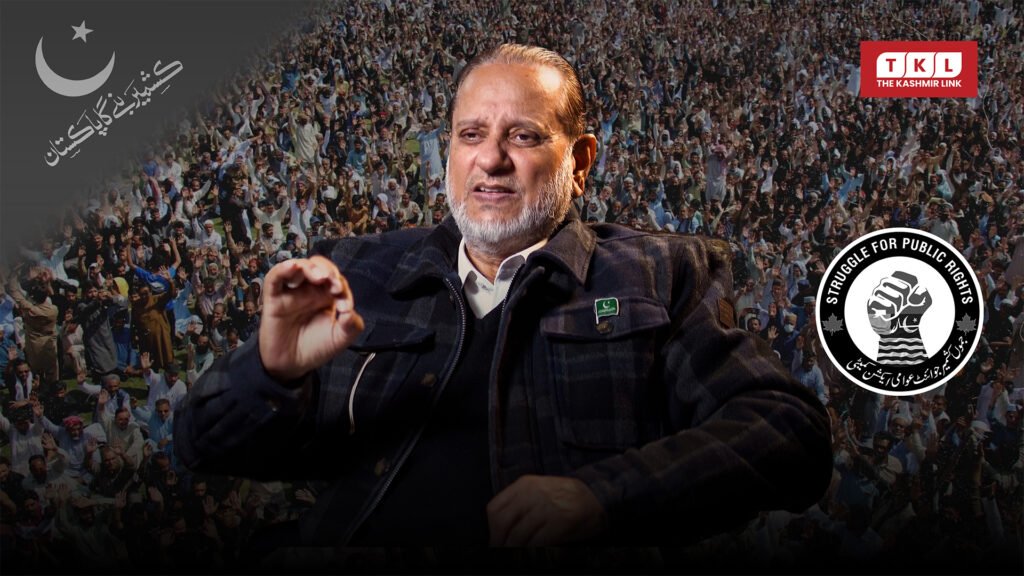
The Former Prime Minister of Azad Jammu & Kashmir and President of the All Jammu & Kashmir Muslim Conference has offered a comprehensive political assessment of the recent unrest in Azad Kashmir, warning that instability in the region may be part of a broader strategy to weaken its constitutional and ideological status.
In an extensive interview, he emphasized that Azad Kashmir, Gilgit-Baltistan, Jammu, Ladakh, and Indian-Occupied Kashmir are all conflict zones, where political developments cannot always be assumed to be spontaneous or organic.
Referring to the history of the Muslim Conference, he stated that despite nearly 94 years of political struggle, the party’s record shows no involvement in bloodshed, contrasting this with recent protests that resulted in deaths, destruction of property, and attacks on national symbols.
He expressed concern over slogans and actions that openly targeted Pakistan, questioning how such behavior could be linked to legitimate public grievances. According to him, Kashmiris have historically viewed Pakistan as their political, cultural, and emotional refuge.
The former premier also criticized administrative handling of the protests, pointing to governance through emergency circulation under Article 22, lack of cabinet consultation, and inflammatory public statements made by the sitting Prime Minister of AJK.
Addressing economic demands, he acknowledged public hardship but termed some proposals—particularly electricity pricing—as impractical and unsustainable, warning that unrealistic promises could destabilize the region further.
He also referenced allegations of foreign funding, coordinated media campaigns, and a diplomatic “cipher” discussed at Kashmir House, stating that while he personally had not examined the document, senior leadership had acknowledged its authenticity at the time.
Concluding his remarks, he warned that ideological and political destabilization of Azad Kashmir has historically been the first step toward sidelining the Kashmir issue internationally, urging political maturity, institutional strength, and unity around Kashmir’s core cause.


