




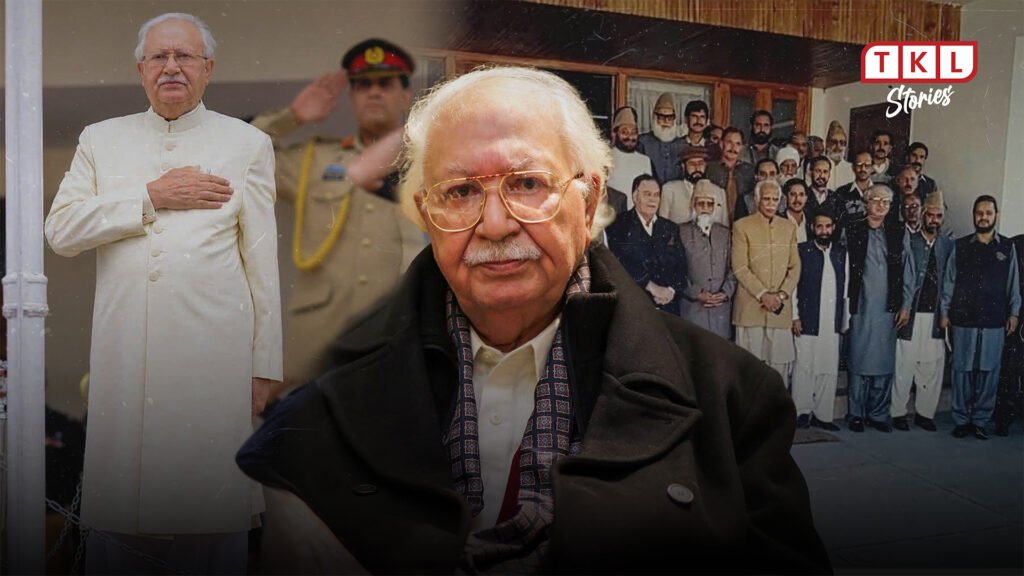
The former AJK president’s nearly six-decade political career was marked by party changes, electoral contests, political alliances and ministerial responsibilities.
Raja Muhammad Zulqarnain Khan, a former president of Azad Jammu and Kashmir, spent nearly six decades in politics, rising from local government in his native village of Kasmah in Bhimber to the highest constitutional office of the state.
His political career, which began in the early 1960s, witnessed several political transitions, changes in party affiliations, electoral victories and defeats, and important government responsibilities. He passed away on November 7, 2026.
Born into a politically influential family, Raja Zulqarnain Khan was the son of Khan Bahadur Raja Muhammad Afzal Khan, an Indian Civil Service officer during British rule who also served in various important positions under Maharaja Hari Singh.
He received his early education in Srinagar and Delhi before attending Lawrence College, Murree. He graduated from Government College Lahore in 1955.
After completing his education, he entered the business sector and established United Builders, a construction company, in Karachi in 1958. The company later expanded its operations to Azad Kashmir, the United Arab Emirates and Iraq.
Entry into politics
Raja Zulqarnain Khan’s formal political career began around 1960–61, when he became associated with K.H. Khurshid, a former private secretary to Quaid-e-Azam Muhammad Ali Jinnah and former president of Azad Kashmir.
He initially entered politics at the local level and was elected chairman of the Union Council of Kasmah under the Basic Democracies system.
In 1962, when K.H. Khurshid established the Jammu and Kashmir Liberation League, Raja Zulqarnain Khan became its founding secretary-general.
He was given his first ministerial responsibility in the Azad Kashmir government in 1969.
Electoral politics and ministerial responsibilities
With the introduction of the parliamentary system and the first general elections in 1975, Raja Zulqarnain Khan joined the Pakistan People’s Party and contested from Samahni constituency in Bhimber district. He won the election and became a member of the Legislative Assembly.
Following the 1977 martial law and subsequent political developments, he changed his political affiliation and joined the All Jammu and Kashmir Muslim Conference.
He won the 1985 general elections from Bhimber on the Muslim Conference ticket. In the government led by Sardar Sikandar Hayat Khan, he was entrusted with several important portfolios, including Finance, Planning and Development, Health and Revenue.
He lost the 1990 general elections to Pakistan People’s Party candidate Chaudhry Sohbat Ali but returned to the Assembly after winning the 1991 elections.
During Sardar Abdul Qayyum Khan’s government, he was again assigned the Finance and Planning and Development portfolios.
In 1996, he entered the Kashmir Council after being elected as its member. He remained associated with the institution for nearly five years and also served as an adviser to its chairman.
Political differences and rivalries in Bhimber
Raja Zulqarnain Khan’s political career was also shaped by his changing relationship with Chaudhry Tariq Farooq, a prominent political figure from Bhimber.
In the 1996 elections, Raja Zulqarnain Khan supported Chaudhry Tariq Farooq, helping him enter the Legislative Assembly for the first time.
However, political differences gradually emerged between the two leaders.
Their rivalry became more visible in the 2001 elections, when Chaudhry Tariq Farooq contested as an independent candidate against Raja Zulqarnain Khan, who lost the election.
Ahead of the 2006 elections, Raja Zulqarnain Khan opposed Chaudhry Tariq Farooq, who was contesting on a Muslim Conference ticket. Instead, he supported Chaudhry Anwar-ul-Haq, then an emerging political candidate.
Chaudhry Anwar-ul-Haq won the election and entered the Legislative Assembly for the first time.
Election as President of Azad Kashmir
In 2006, the Muslim Conference nominated Raja Zulqarnain Khan for the presidency of Azad Kashmir.
He took oath as the President of Azad Jammu and Kashmir on August 25, 2006, marking the culmination of a political journey that had begun at the local government level nearly five decades earlier.
He remained in office until August 2011, during which Sardar Attique Ahmed Khan served as the prime minister of Azad Kashmir.
His presidential tenure coincided with political changes and differences within the state government. After completing his five-year term, he left the President’s House but remained active in the politics of Bhimber.
Continued political involvement and final party affiliation
Following his presidency, Raja Zulqarnain Khan continued to influence electoral politics in Bhimber.
He supported Chaudhry Anwar-ul-Haq in the 2011 and 2016 general elections, although Chaudhry Tariq Farooq won both contests.
In the 2021 elections, Chaudhry Anwar-ul-Haq contested on a Pakistan Tehreek-e-Insaf ticket and won. Raja Zulqarnain Khan’s support was also associated with his electoral success.
However, political differences subsequently emerged between the two leaders.
In the final phase of his political career, Raja Zulqarnain Khan joined Pakistan Muslim League-Nawaz.
In April 2026, a PML-N delegation met him and invited him to join the party. The following month, his son, Raja Babar Ali Zulqarnain, announced his father’s decision to join PML-N at a public gathering in Bhimber.
He was subsequently appointed vice president of the party.
A political journey spanning six decades
Raja Muhammad Zulqarnain Khan passed away on November 7, 2026, bringing an end to a political career that had witnessed several phases of Azad Kashmir’s political history.
From his election as chairman of the Union Council in Kasmah to his membership of the Legislative Assembly, ministerial responsibilities, membership of the Kashmir Council and eventual election as president, his career reflected the changing political dynamics of the state.
His political journey also included affiliations with the Jammu and Kashmir Liberation League, Pakistan People’s Party, Muslim Conference and, ultimately, Pakistan Muslim League-Nawaz.
His decisions, political alliances and rivalries remained part of the wider political landscape of Bhimber and Azad Kashmir.
With his death, a significant chapter in the political history of Azad Kashmir came to an end.


