




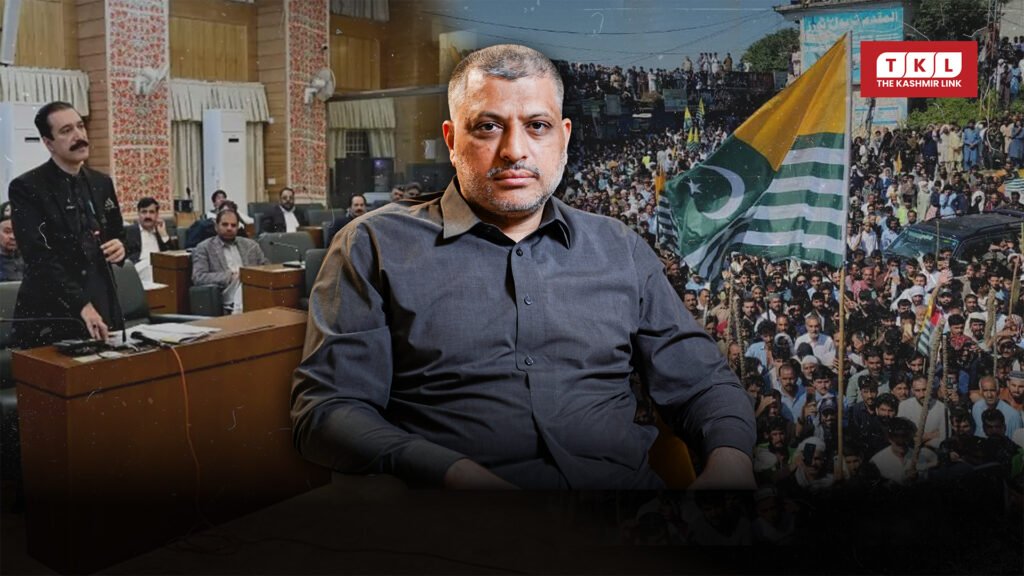
Azad Kashmir’s Identity – On a charged political issue that has stirred debate across Azad Jammu and Kashmir (AJK), Member of Legislative Assembly Ahmed Raza Qadri speaks with certainty.
For him, the controversy over refugee seats is not merely about elections, constituencies, or vote counts. It is about the very identity of Azad Kashmir itself.
“These are not just seats,” he says. “They represent a political reality, a historical struggle, and the unresolved question of Kashmir.”
His words come at a time when the future of the 12 refugee seats in the AJK Legislative Assembly has become one of the most contested topics in regional politics.
Azad Kashmir’s Identity – More Than a Numbers Game
Critics often argue that refugee constituencies have fewer voters compared to local constituencies in Azad Kashmir. They question why such seats continue to exist in the modern political system.
But Qadri rejects the idea that the issue can be reduced to mathematics.
He points to a deeper constitutional framework under the AJK Interim Constitution of 1974, which he says gives legislative authority over all state subjects, wherever they may live.
For him, those displaced from Jammu and the Kashmir Valley are not outsiders. They remain part of the same unresolved political question.
“This is not Ahmad Raza Qadri’s seat,” he says. “It is symbolic representation for millions whose voices remain unheard.”
The Constitution and the Claim
At the center of his argument are Articles 30 and 31 of the AJK Constitution.
Qadri says these provisions make clear that the Assembly’s authority extends beyond the geographical borders of Azad Kashmir and includes state subjects living elsewhere.
That interpretation, he argues, is essential to understanding why refugee representation exists.
If those seats are removed, he warns, a larger question emerges:
Can Azad Kashmir continue to claim representation of the wider Jammu and Kashmir state while excluding a major segment of its displaced population?
Azad Kashmir’s Identity – Calls for Reform, Not Abolition
Qadri acknowledges that criticism over transparency and voter registration cannot be ignored.
He says concerns about fake votes and irregularities are genuine and should be addressed through institutional reform.
According to him, he has already submitted proposals to election authorities seeking:
- Verification of state subject certificates
- Purification of voter lists
- Elimination of fake votes
- Greater transparency in elections
“The flaws should be fixed,” he says. “But destroying the whole system is not the answer.”
A Fear of Political Drift
Beyond elections, Qadri sees something more troubling.
He believes attempts to end refugee representation are part of a gradual shift away from the wider Kashmir cause and toward a narrower territorial politics.
For him, the issue is not just administrative—it is strategic.
He warns that if symbolic links with the rest of the former princely state are severed, Azad Kashmir could risk losing the moral and political basis of its unique status.
Azad Kashmir’s Identity – A Battle of Narratives
The debate has also moved far beyond assembly halls.
On social media, in public gatherings, and across political circles, refugee seats have become shorthand for bigger frustrations about governance, inequality, and identity.
Supporters of reform say change is overdue.
Defenders like Qadri say reform must happen without erasing history.
What Comes Next?
As Azad Kashmir moves toward future elections, the dispute over refugee seats is unlikely to fade.
For some, they are outdated relics of another era.
For others, they are living proof that the Kashmir question remains unresolved.
And in that tension lies the real story: not simply who gets to vote, but who gets to belong.
The battle over 12 seats is ultimately a battle over memory, legitimacy, and the future direction of Azad Kashmir.
Whether they remain or are reformed, one thing is clear: these seats carry far more weight than their number suggests.


