




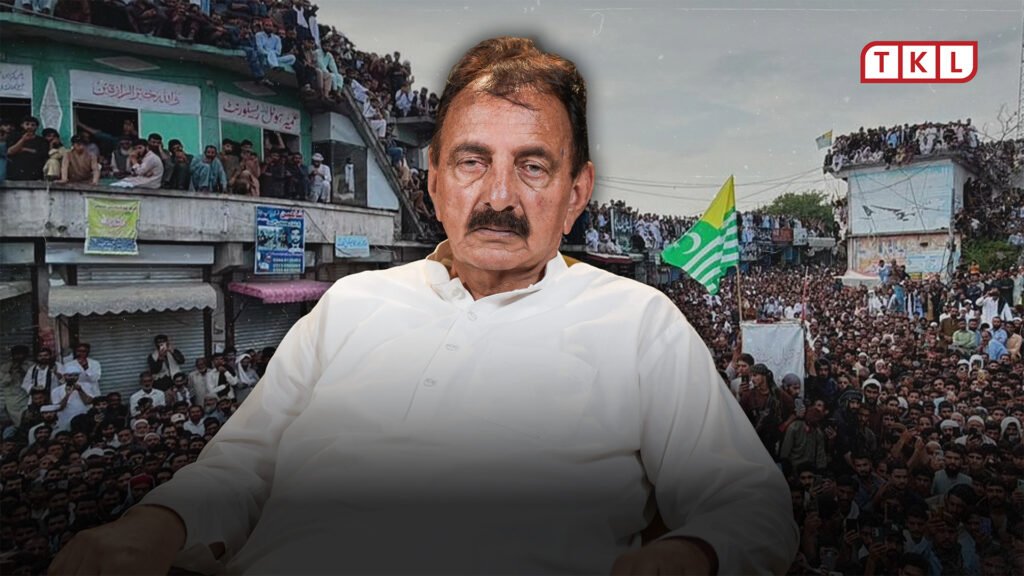
Poonch crisis – Lawyer and politician Sardar Javed Nisar Khan has called for dialogue between the Azad Kashmir government and the Awami Action Committee, arguing that the ongoing situation in District Poonch cannot be resolved through force.
In an interview with The Kashmir Link, Khan said the government should engage with the Action Committee over demands that fall within the constitutional and legal framework.
He questioned the continued confrontation between the state and protesters and said the government should provide the Action Committee with enough political space to end the sit-in without losing face.
“The state is bigger,” Khan said, arguing that the government should take the initiative to resolve the dispute rather than insist that protesters first surrender.
Poonch crisis – No writ of government
Describing the situation in Poonch, Khan said government institutions were not functioning normally and claimed that security forces had been deployed around government offices and other parts of the city.
He said the situation had created uncertainty about the functioning of the administration and argued that the writ of government was not visible in the district.
According to Khan, the continuing restrictions had also affected ordinary residents, with problems ranging from movement and food supplies to education and healthcare.
Poonch crisis – Calls for dialogue
Khan said the government should begin negotiations on demands that are constitutionally permissible.
He particularly questioned why notifications relating to demands accepted by the authorities had not been issued.
He argued that insisting on surrender before negotiations had created an unnecessary deadlock.
“The government has to give them some space,” he said, suggesting that a limited concession could provide the Action Committee with a way to end the confrontation while allowing the government to retain its authority.
Poonch crisis – Questions over handling of the crisis
Khan also criticised what he described as the mishandling of the situation.
He referred to earlier confrontations and alleged that the use of force had contributed to an escalation of tensions.
Khan said both civilians and members of the security forces had suffered losses and stressed that the death of any person was a matter of grief.
He warned that further use of force could result in additional casualties and argued that neither Pakistan nor Azad Kashmir would benefit from continued confrontation.
Poonch crisis – Civilian hardship
A major part of the interview focused on the impact of the crisis on everyday life in Poonch.
Khan highlighted restrictions on movement, disruption to educational activities and difficulties in accessing healthcare.
He also raised concerns about internet connectivity and its impact on students, including students enrolled in medical colleges.
According to him, prolonged disruption was affecting students’ academic careers and had reportedly prompted some students to seek migration to other institutions.
He also questioned how residents could access emergency medical treatment when roads remained blocked or difficult to use.
Poonch crisis – Food supplies and prices
Khan said restrictions on movement had also affected the supply of food and other essential commodities to Rawalakot.
He gave the example of vegetables being transported from Rawalpindi and said additional charges on vehicles carrying supplies were contributing to higher prices in Rawalakot.
He argued that ensuring the movement of essential commodities was primarily the responsibility of the government.
Refugee seats and political strategy
Khan also discussed the Action Committee’s position on refugee seats in the Azad Kashmir Legislative Assembly.
He said the Assembly had the legal authority to amend the relevant law and either abolish, reduce or otherwise change the refugee seats.
However, he questioned what he described as the urgency with which the issue had been incorporated into the wider protest movement.
Khan said political movements generally involve both short- and long-term objectives and argued that different demands should have been treated differently.
Second-tier leadership should make contact
As a possible way out of the crisis, Khan proposed that political figures who are not directly part of the Action Committee should initiate contact with its leadership.
He said he was prepared to play his role alongside other political figures and suggested that a broader effort should be made to persuade the Action Committee to end the sit-in.
According to Khan, the government ultimately has to create the political space necessary for such an engagement.
He urged the Azad Kashmir government to immediately focus on the situation in Poonch and address the problems affecting residents, particularly children, students and patients.
Khan concluded that a collective effort to resolve the dispute was necessary to prevent further harm to the people of Poonch and to the wider state.


