




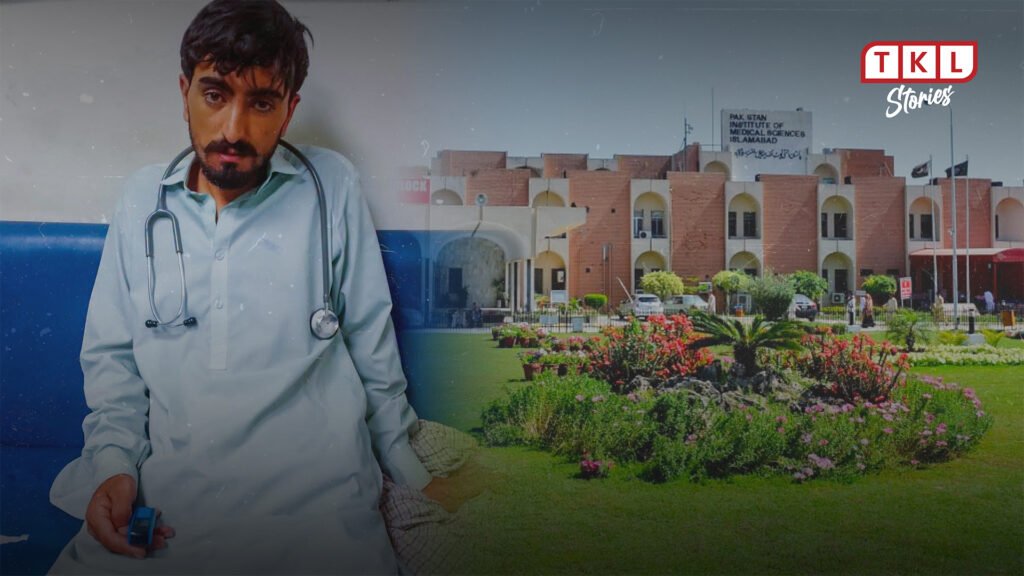
PIMS Fake Doctor — Pakistan Institute of Medical Sciences (PIMS), Islamabad’s largest public-sector hospital, has come under renewed scrutiny following the arrest of a man who police allege was posing as a doctor inside the hospital.
The case emerged just days after the deaths of 14 newborn babies in a fire at the hospital’s nursery ward, an incident that had already raised serious questions about the hospital’s administration and safety arrangements.
The man arrested in the latest case has been identified as Mazhar Qayum Mughal, a resident of Neelum Valley in Azad Kashmir.
But while police records point to allegations of impersonation and fraud, his lawyer has presented an entirely different account.
PIMS Fake Doctor – What happened on August 26?
According to information available about the case, PIMS staff detained Mazhar at around 1:40 a.m. on August 26, 2026.
It was subsequently alleged that he was carrying a fake medical officer’s stamp and a stethoscope and was presenting himself as a doctor.
A criminal case was registered against him at Karachi Company Police Station on August 29, three days after the reported incident.
The FIR invokes Sections 419, 420, 468, 471 and 170 of the Pakistan Penal Code, relating to offences including cheating by personation, cheating, forgery, use of forged documents and personating a public servant.
The complainant named in the FIR is Musaddiq Latif, a resident of Tando Muhammad Khan.
However, it remains unclear from the information available publicly what his official relationship with PIMS is.
The Kashmir Link contacted the complainant, PIMS administration and police officials seeking details about the incident. No detailed response was provided.
PIMS Fake Doctor – A different story from the defence
Mazhar’s lawyer, Advocate Khawaja Sajjad Ahmed, disputes the allegations.
According to the lawyer, Mazhar was not a doctor but an ordinary hotel worker who had been visiting PIMS because of his work and contacts with hospital staff.
The lawyer claims that Mazhar was involved in a dispute with security personnel and was subsequently detained.
He further alleges that a stethoscope was placed around Mazhar’s neck and that a doctor’s stamp was presented alongside him to create the impression that he had been impersonating a doctor.
These allegations have not been independently verified.
The defence has therefore raised questions about the circumstances in which Mazhar was detained and the evidence used to support the case against him.
PIMS Fake Doctor – What do hospital sources say?
Sources at PIMS, however, have provided a different account.
According to people familiar with the situation, Mazhar had been working as a waiter’s assistant at a hotel near the hospital and had been frequently visiting PIMS.
The sources alleged that a complaint was made after a patient reportedly raised concerns about being directed to purchase expensive medicines from a pharmacy rather than being referred through the normal hospital process.
According to this account, hospital staff subsequently detained Mazhar and handed him over to police following an initial inquiry.
The sources also claimed that Mazhar had no professional connection with the medical field.
These claims, however, have not been independently established through official records.
Questions remain unanswered
The conflicting accounts make the case difficult to assess conclusively.
If Mazhar was genuinely impersonating a doctor, several questions remain.
How did he obtain a medical officer’s stamp?
How long had he been visiting PIMS?
Did he actually examine patients?
Did he receive money from patients or their families?
Was there any previous complaint against him?
And how did hospital security fail to identify him if he had been regularly moving around the premises?
On the other hand, if the defence version is correct, then an equally serious set of questions arises.
Why was Mazhar allegedly presented as a doctor?
Who put the stethoscope around his neck?
Where did the alleged medical stamp come from?
Was any video recorded at the time of his detention?
And what happened between August 26, when he was reportedly detained, and August 29, when the FIR was registered?
The missing three days
The three-day gap between the reported incident and registration of the FIR is particularly significant.
It remains unclear where Mazhar was during this period, whether he remained in police custody, whether he was questioned before the FIR was registered, and what evidence was collected during those three days.
CCTV footage from the hospital could potentially clarify the sequence of events.
Hospital entry records, security logs, pharmacy records and statements from patients or staff could also help establish whether Mazhar had actually been impersonating a doctor or whether the incident developed from a dispute unrelated to impersonation.
No final conclusion yet
At present, the case consists of competing versions.
The police have registered an FIR alleging impersonation, fraud and forgery.
The defence lawyer denies the allegations and claims Mazhar was framed.
Other claims about Mazhar’s background and alleged previous activities have also surfaced, but these have not been independently verified and should not be treated as established facts.
PIMS administration and police have so far not provided detailed public information that would conclusively resolve the conflicting accounts.
The case therefore raises questions not only about the alleged impersonation but also about hospital security, the circumstances of the arrest and the delay between the reported incident and registration of the FIR.
Until CCTV footage, hospital records, police evidence and statements from all relevant parties become available, it would be premature to conclude whether Mazhar Qayum Mughal was genuinely impersonating a doctor or whether, as his lawyer claims, he became the subject of a fabricated case.
For now, the FIR is on record.
So is the defence’s version.
The central facts, however, remain to be established through evidence and a transparent investigation.


