




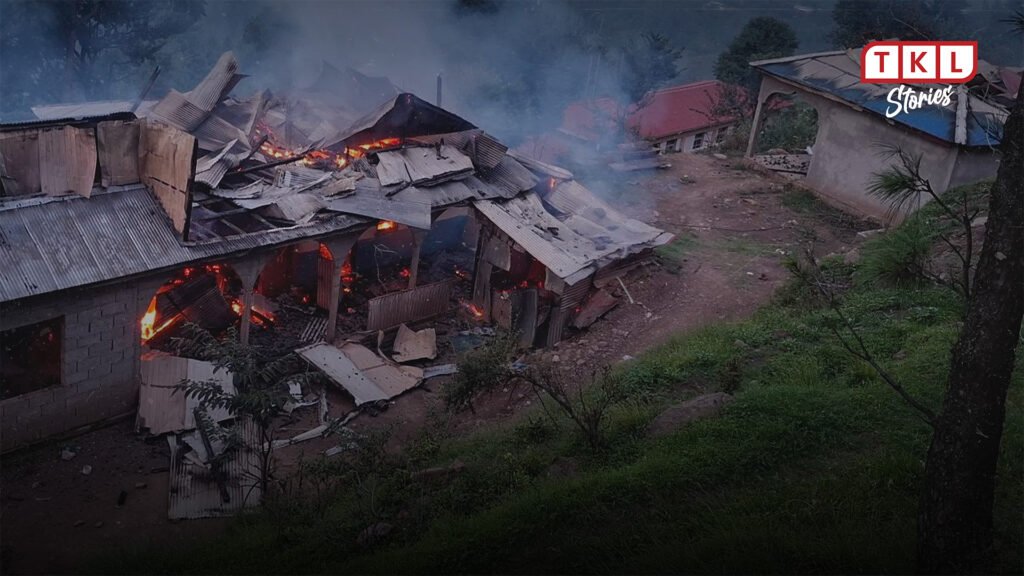
Kot Tarhala Muzaffarabad — What began as a dispute between two families in a mountainous village of Azad Kashmir turned into a deadly cycle of violence, leaving several people dead and injured and raising questions about the role of longstanding land and community rivalries.
The violence unfolded in Kot Tarhala village in the Khawra area of Muzaffarabad district on August 14 and 15, when Pakistan was preparing to celebrate Independence Day.
According to local reports and police-confirmed accounts cited by local media, gunfire first erupted on August 14 following tensions between two sides. At least two people were killed in the initial clash, while several others were injured.
The following day, violence erupted again during the funeral gathering of the victims. Two more people were reported killed in the second incident.
The circumstances surrounding the violence, however, remain contested, with different accounts emerging about what triggered the confrontation.
Kot Tarhala – A dispute with more than one version
Available local reporting has primarily linked the initial confrontation to a land dispute between two sides.
According to these reports, tensions had existed between the families before the incident and eventually escalated into armed violence.
Other accounts circulating on local social media have presented a different version, suggesting that the confrontation began after a minor dispute involving a fight between dogs belonging to young men from the two sides.
The two narratives appear dramatically different.
One points to a longstanding dispute over land, while the other describes a seemingly insignificant incident that spiraled into deadly violence.
But local conflicts rarely develop from a single moment.
Longstanding disagreements over property, family honour, community influence and local rivalries can remain unresolved for years before a relatively minor incident brings those tensions to the surface.
In Kot Tarhala, the precise sequence of events and the circumstances that triggered the first exchange of fire remain matters for investigation.
Kot Tarhala – Gunfire turns a village into a battlefield
The initial shooting did not end the violence.
Local reports said that houses belonging to members of the Raja community were subsequently set on fire.
The reported arson added another dimension to an already volatile situation, suggesting that the confrontation had moved beyond the individuals directly involved in the original dispute.
For residents, the consequences were immediate.
A village that had begun the day with its normal routine was suddenly dealing with deaths, injuries, fear and damage to property.
The incident also raised concerns that the confrontation could develop into a wider communal or family feud.
Kot Tarhala – Funeral becomes another scene of violence
The violence took an even more disturbing turn on August 15.
The community had gathered for the funeral prayers of those killed the previous day. In rural communities, funerals traditionally provide a moment when personal and family differences are set aside to mourn the dead.
But in Kot Tarhala, gunfire reportedly erupted during the funeral gathering.
According to police-confirmed reporting cited by local media, two additional people were killed and several others injured in the second episode of firing.
The development transformed what should have been a moment of mourning into another scene of bloodshed.
It also raised a fundamental question: if tensions between the two sides were already known, why was a funeral gathering not adequately protected?
How many people were killed?
The exact death toll has become another point of confusion.
Some social media posts and local reports have claimed that as many as six people were killed in the violence. Other claims have suggested that dozens of houses and shops were also burned.
However, the police-confirmed reporting available in the aftermath clearly documented two deaths during the initial clash and two additional deaths during the funeral-related firing.
That puts the clearly confirmed death toll at four, although further verification is necessary before accepting or rejecting higher figures circulating on social media.
The discrepancy highlights a recurring problem in the immediate aftermath of violent incidents: information can move faster than verification.
For families of the victims, however, these are not merely numbers.
Every figure represents a person, a family and a life permanently changed by the violence.
Land dispute, political rivalry—or both?
Another unanswered question concerns the wider context of the confrontation.
While several local accounts describe the incident primarily as a land dispute, allegations of political rivalry have also emerged.
There is currently insufficient verified evidence to establish that political competition was a direct cause of the violence.
Yet the possibility cannot simply be dismissed without investigation.
In small communities, disputes over land, family influence, social standing and politics can overlap. A property dispute can acquire political dimensions, while political rivalries can intensify existing family conflicts.
For that reason, reducing the Kot Tarhala incident to a simple “land dispute” may not explain the entire chain of events.
Questions over the police response
The incident has also raised questions about the response of the local administration and police.
If tensions between the two sides had existed before the shooting, were authorities aware of them?
Were there previous complaints, cases or warnings?
And after the first deadly clash on August 14, what security arrangements were put in place for the funerals the following day?
Police reportedly took action and arrested some individuals following the violence.
But an arrest is not a determination of guilt.
That can only be established through a fair investigation and due judicial process.
A credible investigation would need to establish the sequence of events, identify those responsible for the firing and arson, determine whether weapons were used by multiple individuals and examine whether any prior warnings or complaints were ignored.
A village left with a deeper wound
The immediate violence may have ended, but the consequences for Kot Tarhala are likely to last much longer.
Families have lost relatives. Others may have lost homes, businesses or property. Children have witnessed violence that may remain with them for years.
Perhaps the greatest danger now is that the killings could create a cycle of retaliation.
In communities where family and communal loyalties are strong, one death can become the justification for another, turning an isolated confrontation into a prolonged feud.
Preventing that cycle will require more than arrests.
It will require an impartial investigation, accountability for those responsible, protection for affected families and efforts to rebuild trust between the communities involved.
The questions that remain
The Kot Tarhala violence has generated several unanswered questions.
What exactly triggered the first confrontation?
Was the incident the result of a longstanding land dispute, a minor quarrel, or a combination of several unresolved conflicts?
Were political or community rivalries involved?
Who fired the first shots?
Who was responsible for the subsequent deaths?
Who set houses or other property on fire?
And why did violence erupt again at a funeral after the first deadly confrontation?
These questions cannot be answered through social media claims or competing narratives.
They require evidence, witnesses, forensic investigation and an independent judicial process.
For the people of Kot Tarhala, the immediate need is not another version of the story.
It is the truth.
Because beyond the disputed numbers and competing explanations are families mourning their dead, people recovering from injuries and a village struggling to regain the trust and sense of security it lost in two days of violence.
The real story of Kot Tarhala may therefore be more than a dispute that ended in gunfire.
It is also a test of whether a community—and the institutions responsible for protecting it—can prevent a local conflict from becoming a cycle of bloodshed.


