




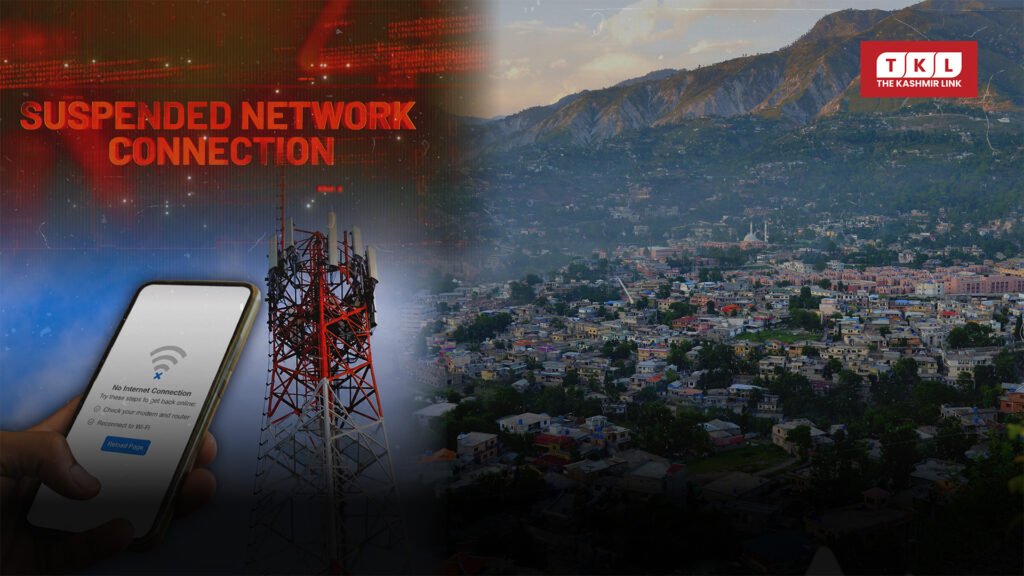
Internet Shutdown – More than a month after internet services were suspended across large parts of Azad Jammu and Kashmir (AJK), the disruption has evolved far beyond a communications blackout. What initially appeared to be a temporary security measure has developed into a crisis affecting nearly every aspect of public life—from banking and education to digital businesses, tourism, family communication, and political engagement.
For thousands of residents, the absence of internet access has transformed routine daily activities into complex challenges. Financial transactions that once took seconds now require physical visits to bank branches. Students struggle to access online educational resources. Freelancers have lost contact with international clients, while businesses dependent on digital payments and online services have seen operations severely disrupted.
As AJK approaches elections for its Legislative Assembly, concerns are also growing over the implications of prolonged digital restrictions for access to information and public participation.
Digital Connectivity Is No Longer a Luxury
The internet has become a critical component of modern infrastructure. Around the world, governments, businesses, educational institutions, healthcare providers, and financial systems increasingly rely on digital connectivity to deliver essential services.
For ordinary citizens, internet access now underpins everything from banking and employment to education, healthcare appointments, business communication, and maintaining family relationships.
Recognizing this transformation, the United Nations has repeatedly emphasized that access to the internet plays an important role in enabling the exercise of internationally recognized human rights, including freedom of expression, access to information, education, and participation in public life. Human rights organizations have similarly argued that restrictions on internet access should remain exceptional, proportionate, and limited in duration because extended shutdowns can affect multiple aspects of everyday life.
The current situation in Azad Kashmir illustrates how deeply societies have become integrated with digital technologies.
Internet Shutdown – Families Separated by Silence
Perhaps the most immediate consequence has been the disruption of communication between families.
Thousands of Kashmiris have close relatives living in Pakistan’s major cities, the Gulf region, Europe, and North America. For many households, daily communication through messaging applications and video calls has become an essential part of family life.
Since internet services were suspended, many residents have found themselves unable to communicate regularly with loved ones abroad. Some families now rely on telephone calls routed through relatives outside the affected areas, while others wait days before receiving updates about family members.
For elderly parents and relatives accustomed to daily conversations, the prolonged disruption has created anxiety and uncertainty.
Internet Shutdown – Banking and Commerce Under Pressure
The shutdown has also disrupted the financial system.
Modern banking increasingly depends upon secure internet connectivity. Mobile banking applications, online fund transfers, digital payment platforms, and interbank services have become central to both personal finance and commercial activity.
Business owners report delays in receiving payments, while customers face difficulties completing routine transactions. Many retailers who had shifted toward digital payment methods now rely almost entirely on cash transactions, reducing efficiency and limiting commercial activity.
For businesses operating across multiple cities or provinces, communication with suppliers and customers has become significantly more difficult.
Internet Shutdown – Freelancers Lose Access to Global Markets
Few sectors have been affected as directly as the digital economy.
Over the past decade, freelancing has become an important source of employment for many educated young people in Azad Kashmir. Software developers, graphic designers, video editors, digital marketers, translators, writers, and IT consultants regularly serve international clients through online platforms.
These professionals depend entirely on stable internet connectivity to communicate with clients, submit projects, attend virtual meetings, and receive payments.
With services suspended for weeks, many freelancers report missing deadlines, losing contracts, and damaging long-term professional relationships that often take years to build.
For many households, freelancing represents a primary source of income rather than supplementary employment, making the economic consequences particularly significant.
Education Interrupted
Educational institutions have also experienced considerable disruption.
University students increasingly rely upon digital libraries, academic journals, learning management systems, and online research databases.
Many students preparing applications for foreign universities, scholarships, or professional examinations have found themselves unable to meet application deadlines or access required materials.
Although traditional classroom teaching continues in many institutions, the digital resources that have become an essential component of higher education remain largely inaccessible.
Researchers and university faculty members have similarly faced obstacles in accessing international academic publications and collaborating with colleagues.
Tourism Faces Additional Challenges
The tourism sector, already weakened by protests, travel restrictions, and seasonal uncertainty, has suffered another setback due to the prolonged internet shutdown.
Hotels, guest houses, transport operators, tour guides, and local businesses increasingly depend on online booking platforms, digital payments, and internet-based marketing to attract visitors.
Without reliable connectivity, many businesses have struggled to communicate with potential tourists, confirm reservations, or process electronic payments.
The disruption has added further pressure to an industry that contributes significantly to local employment and supports thousands of small businesses across destinations including Neelum Valley, Leepa Valley, Rawalakot, and other popular tourist regions.
Information Gaps and Public Confidence
Another consequence of limited internet access has been the growing challenge of information verification.
In an environment where official announcements and reliable news sources are difficult to access digitally, rumors and unverified information often circulate more rapidly through informal networks.
Without timely access to official statements or trusted media outlets, residents may struggle to distinguish between verified information and speculation, contributing to public uncertainty.
Communication experts frequently note that transparent and timely information becomes particularly important during periods of political tension or public emergencies.
Elections in a Digital Age
The timing of the shutdown has also drawn attention because Azad Kashmir is moving toward Legislative Assembly elections.
Modern election campaigns increasingly rely on digital communication. Political parties announce rallies, publish manifestos, engage with voters, and respond to public concerns through online platforms.
For many first-time and younger voters, social media has become one of the primary sources of political information.
Prolonged internet restrictions may therefore limit access to campaign material, political debate, and election-related information for sections of the electorate that primarily consume news online.
Election observers worldwide have increasingly recognized access to information as an important component of informed democratic participation.
Looking Beyond the Shutdown
While the immediate challenges are visible across multiple sectors, analysts suggest that the longer-term consequences may extend beyond the period of the shutdown itself.
Businesses disrupted for weeks may require additional time to recover lost revenue. Freelancers may need months to rebuild relationships with overseas clients. Tourism operators could face continued booking uncertainty even after connectivity is restored.
The experience has also highlighted the growing dependence of modern economies on digital infrastructure.
In today’s interconnected world, internet connectivity is no longer simply a technological service. It has become an essential public utility supporting economic activity, education, communication, financial services, and civic participation.
As Azad Kashmir continues to navigate political tensions and public demonstrations, the prolonged internet shutdown has become a reminder that decisions affecting digital connectivity now carry consequences far beyond the online world.
When digital networks fall silent, the effects ripple through homes, classrooms, businesses, financial institutions, and communities—reshaping everyday life in ways that continue long after the screens go dark.


