




As Pakistan emerged on the world map in 1947 and Azad Kashmir was liberated soon after, the flow of information depended entirely on newspapers and radio. Radio Pakistan and Radio Azad Kashmir served as the primary lifeline through which news, state messaging, and political debates reached the public. With the arrival of television in the 1960s—first in black and white and later in color—the media landscape began to expand. For decades, a single state-run television channel played an outsized role in shaping public discourse, relied upon equally by rulers, cabinet members, and opposition leaders.
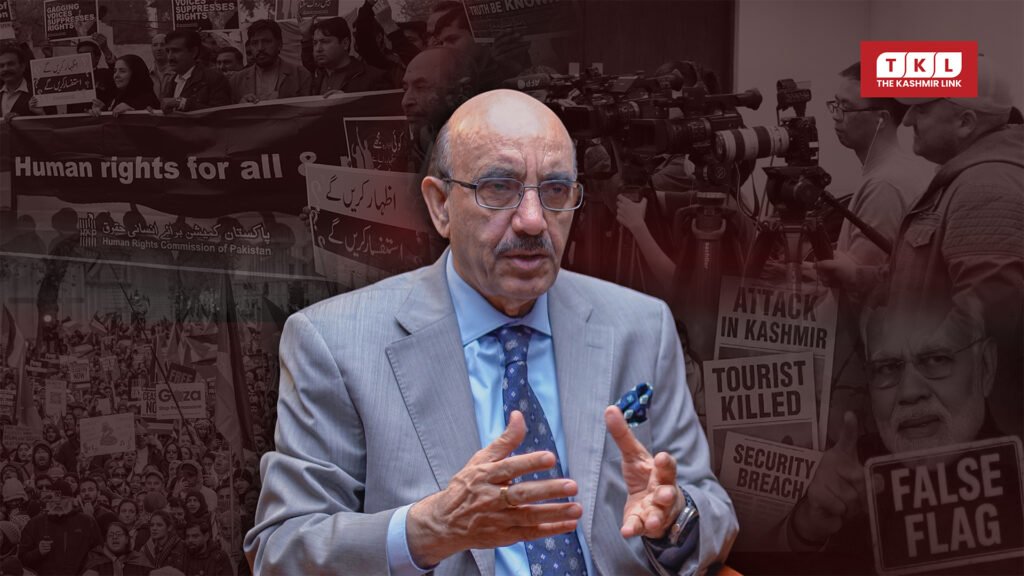
That era has long passed. The introduction of private television networks in the early 2000s sparked a media revolution, turning Pakistan into a country with dozens of round-the-clock news channels. Today, according to Masood Khan—former President of Azad Jammu and Kashmir and Pakistan’s former Ambassador to the United States—this evolution has transformed not only the tools of communication but the very nature of truth itself.
A New Media World: From Traditional Outlets to the Age of AI
The rise of social media marked the next major shift. What began as an extension of digital communication soon became a multidimensional global force, redefining journalism, political activism, and public engagement.
“But now,” Masood Khan notes, “with the advent of AI, the direction and meaning of media have completely changed.”
He emphasizes that in every era, media has played a foundational role as the voice of the people and a crucial channel for governments to convey their message. Strong media ecosystems, he argues, are essential for protecting civil liberties and ensuring citizens’ rights. In societies where media is weak or absent, freedom becomes impossible.
However, the digital age has made it increasingly difficult to separate truth from falsehood. The volume of misinformation, disinformation, and propaganda has grown exponentially, demanding new tools, new literacy, and a modern regulatory framework that the world has yet to fully develop.
Kashmir’s Narrative Battle: Truth Versus Propaganda
Commenting on Kashmir’s ongoing communication challenges, Masood Khan describes the region as a frontline in the global contest between truth and falsehood.
“India has been lying about Kashmir since 1947—perhaps even earlier,” he says, noting that Kashmiris themselves remain the living proof of the truth. Pakistan’s consistent stance at global forums, reinforcing the right to self-determination for the people of Jammu & Kashmir, continues to challenge India’s narrative.
For Masood Khan, this struggle rests on three pillars:
- Diplomacy
- Media and communication
- Scholarship and intellectual output
He believes Pakistan and Azad Kashmir have capable individuals but have not yet fully tapped into the potential of social media to advance their narrative.
The Missing Link: Social Media Literacy
Across the world—from India to the United States—governments use organized social media strategies to shape narratives. Pakistan’s efforts, Masood Khan argues, are not yet at the level they should be.
On the private side, he notes, social media has become profitable for the first time in recent years. Influencers and digital creators now earn based on engagement, but content remains the real challenge.
“We have creative talent,” he says, “but the message that needs to be delivered—whether from the perspective of Pakistan, its people, or our developmental priorities—is still missing.”
He stresses the need for systematic training and education. Media literacy and communication studies, he suggests, should begin at the primary level and remain available as an elective subject up to matriculation. A society where every citizen understands media is better equipped to challenge misinformation.
Media Independence With National Responsibility
Masood Khan advocates for editorial independence while also emphasizing the need for national consensus on priorities. He references global norms: American journalists protect American interests; Chinese journalists understand their responsibility to amplify the voices of their people.
Pakistan and Azad Kashmir, he suggests, must also establish similar clarity without compromising journalistic freedoms.
The Growth of Media in Azad Kashmir
The former AJK President reflects on the evolution of journalism in the region. During his youth, Azad Kashmir had only a handful of weekly or bi-weekly newspapers and a couple of magazines. By the time he held office, nearly 30 newspapers—big and small—were in circulation. Many had their own printing presses in cities like Muzaffarabad, Mirpur, and Rawalakot, while others ran dedicated AJK editions from Pakistani publications.
He highlights a major achievement: the shift to digital media. Even when abroad, he routinely accessed digital editions of newspapers originating from Azad Kashmir—an important milestone for a small but dynamic media community.
The Role of the Kashmiri Diaspora
The global Kashmiri diaspora, especially the 1 to 1.2 million Kashmiris in the United Kingdom, plays a major role in keeping the Kashmir dispute alive. Their representation in political and legal circles—extending to the House of Commons, the House of Lords, and local councils—gives them unique influence.
However, Masood Khan has repeatedly urged them to involve the younger generation in reclaiming ownership of the Kashmir cause. He observed that many young activists were more vocal on the issue of Palestine than Kashmir, and encouraged them to channel the same energy into highlighting their own homeland’s struggle.
In other regions like the Gulf, activism remains limited, while in North America—particularly Canada and the U.S.—Kashmiris have mobilized effectively. Activists such as Dr. Ghulam Nabi Fai have kept the issue alive, though many migrants from Indian-administered Jammu and Kashmir remain cautious due to transnational repression against their families back home.
August 5, 2019: A Turning Point
The most dramatic shift in recent history occurred when India revoked Articles 370 and 35-A, stripping Jammu & Kashmir of its special status. Masood Khan calls this an attempt to “bury the Kashmir issue,” in violation of UN Security Council resolutions that prohibit unilateral changes to the region’s status.
Pakistan, he points out, has upheld its commitments under international agreements. Azad Kashmir continues to exist exactly as it was established in 1947, whereas India has progressively eroded autonomy in the territories under its control.
Despite India’s actions, the Kashmir issue remains very much alive—kept afloat by diplomacy, media efforts, grassroots activism, and the global Kashmiri diaspora.
The Way Forward
Masood Khan’s reflections offer a clear message: the media landscape has changed more in the past two decades than in the previous century. To navigate this new world—shaped by AI, social media, and rapid information flows—Pakistan and Kashmir must invest in:
- Media literacy and education
- Strategic communication
- A unified national narrative
- A stronger global presence through diaspora engagement
In a time when the line between truth and falsehood is increasingly blurred, strengthening independent yet responsible media is essential—not only for Pakistan and Azad Kashmir, but for the global struggle for justice and self-determination in Kashmir.


