




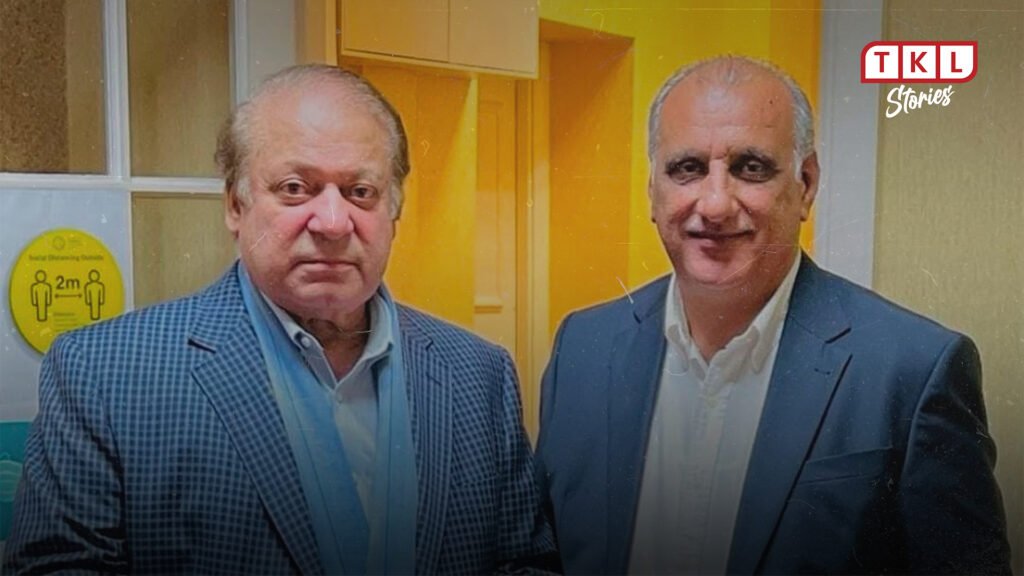
Dr Najeeb Naqi – An election campaign, a road accident and an unexpected political succession set Dr Muhammad Najeeb Naqi Khan on a path that, more than three decades later, has taken him to the presidency of Azad Jammu and Kashmir.
Dr Najeeb Naqi Khan was elected the 25th President of Azad Jammu and Kashmir on September 24, 2026, securing 32 votes in the presidential election. Pakistan Peoples Party candidate Chaudhry Latif Akbar received 12 votes.
But the road to the presidency began not with a presidential contest, but with a tragedy during an election campaign in 1990.
Dr Najeeb Naqi – The accident that changed his course
Dr Najeeb Naqi was born in Rawalpindi on January 19, 1964. He received his early education at Aitchison College and later completed his MBBS from King Edward Medical College in Lahore.
His father, Colonel Muhammad Naqi Khan, was himself active in Azad Kashmir politics and had served as a minister in the AJK government.
During the 1990 general election campaign, Colonel Muhammad Naqi Khan was killed in a road accident. Following his father’s death, Dr Najeeb Naqi entered practical politics and contested the 1991 elections from the platform of the Muslim Conference.
He won the election and entered the AJK Legislative Assembly for the first time.
Thus began a political career that would repeatedly take him between government, opposition and constitutional institutions.
Dr Najeeb Naqi – From first-time MLA to parliamentary secretary
During his first term, from 1991 to 1996, Dr Najeeb Naqi served as Parliamentary Secretary for Health and Planning and Development.
He returned to the Assembly in 1996, this time as an opposition member, and became associated with the Public Accounts Committee.
Between 2001 and 2006, he served as a member of the Kashmir Council.
The sequence gave him experience of several different sides of AJK’s political system: the Legislative Assembly, the government, the opposition and the Kashmir Council.
He returned to the Legislative Assembly in 2006 and joined the Muslim Conference government, serving in ministerial roles including Health, Education and Information Technology. Contemporary profiles of his political career record his five elections to the Assembly from the Pallandri area and his five-year tenure on the Kashmir Council.
Dr Najeeb Naqi – The PML-N chapter
Another important turning point came in 2011, when Dr Najeeb Naqi left the Muslim Conference and joined the Pakistan Muslim League-Nawaz.
He contested the 2011 general elections on the PML-N ticket and won from his constituency in Sudhanoti.
The following five years were again spent largely on the opposition benches, where he was associated with the Public Accounts Committee.
In the 2016 general elections, he returned to the Assembly once again on the PML-N ticket.
This time, he became part of the government and was given important portfolios including Finance, Planning and Development and Health. His ministerial responsibilities placed him at the centre of policymaking in areas ranging from public finances and development planning to healthcare.
Dr Najeeb Naqi – Pallandri and Sudhanoti
Much of Dr Najeeb Naqi’s political identity has remained connected to Pallandri and Sudhanoti.
Among the development initiatives associated with his political career are efforts that led to Sudhanoti receiving district status in 1995 and the completion of Cadet College Pallandri. A profile published during his earlier political career also identified the development of District Hospital Sudhanoti among the projects associated with his constituency.
For him, therefore, politics was not only a journey through offices in Muzaffarabad. It was also closely tied to a constituency in the hills of Poonch Division, where he repeatedly sought election.
Defeat in 2021
The uninterrupted electoral run came to an end in the 2021 general elections, when Dr Najeeb Naqi lost his Assembly seat.
After three decades of political activity, he was suddenly outside the Legislative Assembly.
Yet his political career was far from over.
An unusual coincidence in 2026
The 2026 general elections produced an unusual coincidence in the story of Dr Najeeb Naqi.
The elections were held in phases. However, polling in seven constituencies of Poonch and Sudhanoti was postponed because of security and law-and-order concerns. Five of the affected constituencies were in Poonch district and two were in Sudhanoti.
Pallandri, Dr Najeeb Naqi’s political home, was among the constituencies where voters did not initially go to the polls.
This meant that while the rest of AJK moved through the 2026 electoral process and a new government was formed, the electoral process in parts of Poonch Division remained incomplete.
The issue also acquired a constitutional dimension because the postponed constituencies represented areas whose voters had yet to directly elect their representatives. As of September 24, reporting indicated that no new polling date had been announced for the seven seats.
From legislator to President
The presidential election was the final major constitutional step following the 2026 general elections.
The office had remained vacant since January 2026 after the death of Barrister Sultan Mahmood Chaudhry. The acting presidency was subsequently held by the speakers of the Legislative Assembly.
The ruling PML-N nominated Dr Najeeb Naqi for the presidency in September. His nomination papers were filed on September 19, with Prime Minister Iftikhar Gillani as seconder and former prime minister Raja Farooq Haider as proposer.
On September 24, the Legislative Assembly became the electoral college for the presidential election.
Dr Najeeb Naqi secured 32 votes, while Chaudhry Latif Akbar received 12. He was consequently elected the 25th President of Azad Jammu and Kashmir.
A different kind of political responsibility
The presidency marks a fundamentally different stage in Dr Najeeb Naqi’s political career.
For more than three decades, his political life was largely connected with electoral politics, constituency representation, parliamentary opposition and government ministries.
As president, his office is constitutional rather than constituency-based.
That distinction is particularly significant at a time when AJK has experienced political tensions, protests and an unsettled electoral process in parts of Poonch Division.
The seven postponed constituencies — including two in Sudhanoti — remain part of that unfinished electoral story.
For a politician whose career began in Pallandri after the death of his father in an election campaign, there is an unusual symmetry in reaching the presidency at a moment when his own political home remains connected to an incomplete electoral process.
Thirty-six years later
Dr Muhammad Najeeb Naqi Khan’s political journey began in the aftermath of an accident.
It continued through five Assembly terms, the Kashmir Council, ministerial offices, opposition politics, a party switch, an electoral defeat and a period outside the Assembly.
Now, 36 years after he first entered electoral politics, he occupies the constitutional office of President of Azad Jammu and Kashmir.
The next chapter of his political life will be different from all those that came before it.
He is no longer representing only Pallandri, Sudhanoti or a political party.
He now occupies an office connected with the constitutional framework of the entire state.


