




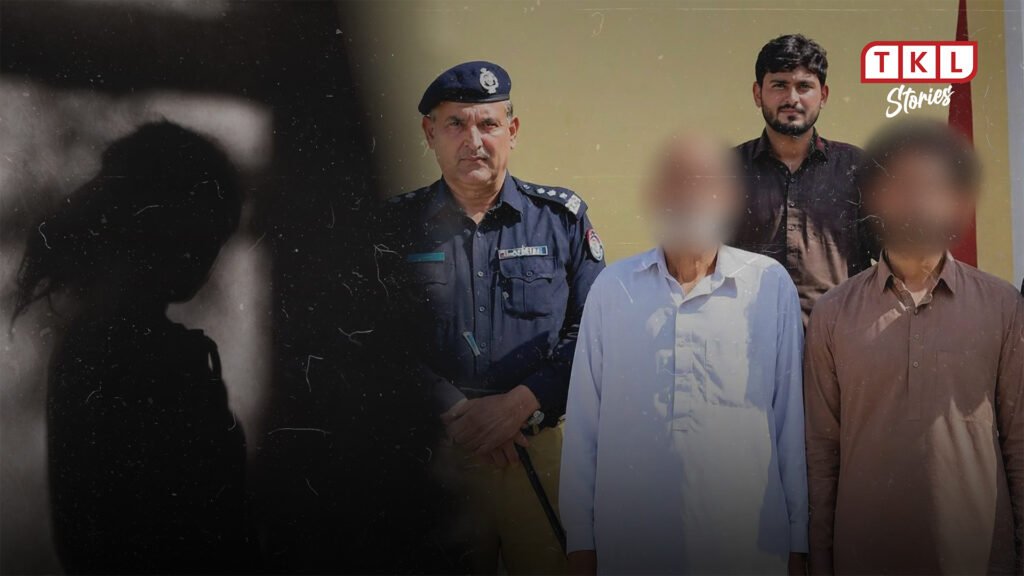
Child Sexual Assault – The incident in Sahliyan, Bagh District, raises broader questions about child protection, law enforcement and access to justice in Azad Jammu and Kashmir.
BAGH, Azad Jammu and Kashmir — Police have arrested two suspects in connection with an alleged sexual assault involving a 14-year-old girl in Sahliyan, in the Dhirkot tehsil of Bagh District, as investigators continue to examine the circumstances of the incident and the possible involvement of others.
According to the account presented in TKL Stories by journalist Osama Sattar Abbasi, the eighth-grade student went missing from her home on the afternoon of October 14, 2026. Her family searched for her throughout the evening and night before filing a missing-person report with the police.
The following morning, the girl’s father received a telephone call from her school, the Red Foundation School in Sahliyan, informing him that his daughter had arrived but that her condition appeared abnormal.
Her father rushed to the school, and police were informed. Rafiqat Abbasi, the station house officer of Sahliyan Police Station, arrived with his team and obtained preliminary information from the girl.
Child Sexual Assault – Police investigate allegations of sexual assault
According to the police account outlined in the report, the initial investigation suggested that the girl had allegedly been taken to an isolated location by a cousin under false pretences and sexually assaulted before being left alone.
The report further states that the girl subsequently reached a cattle shed, where another person allegedly kept her overnight and sexually assaulted her multiple times.
Police arrested two suspects following the complaint. However, investigators have yet to conclude their inquiry into the allegations.
According to the Dhirkot deputy superintendent of police, clear evidence had emerged against the older suspect, while the younger suspect’s alleged role remained under investigation. Police were also examining whether additional individuals had been involved.
The family of the younger suspect has denied the allegations, according to the report.
The allegations have not yet been established through a judicial determination. Both suspects are presumed innocent unless proven guilty in accordance with the law.
Child Sexual Assault – A wider child protection concern
Beyond the individual case, the incident has renewed questions about the protection of children and the ability of public institutions to prevent, investigate and respond to sexual violence in Azad Jammu and Kashmir.
In the TKL Stories report, Abbasi asks: “How effective is our system at protecting children from such crimes?”
The question extends beyond the arrest of suspects to the broader responsibilities of law enforcement, schools, families and relevant government institutions.
Effective responses require timely reporting, professional evidence collection, impartial investigations and access to appropriate medical and psychological support for affected children. Procedures must also protect minors from intimidation, stigma and further trauma during legal proceedings.
Child Sexual Assault – What official statistics reveal
District-level data cited from Azad Jammu and Kashmir’s Statistical Year Book 2025 recorded 102 rape cases between 2021 and 2024.
The reported annual totals were:
– 2021: 27 cases
– 2022: 18 cases
– 2023: 35 cases
– 2024: 22 cases
According to the district breakdown cited in the report, Muzaffarabad recorded the highest number, with 20 cases. Mirpur reported 15, while Poonch and Bhimber recorded 14 each. Jhelum Valley reported 11, Sudhnoti 10 and Neelum nine. Kotli recorded six cases, Bagh two and Haveli one.
Separately, the Human Rights Commission of Pakistan (HRCP), in its report State of Human Rights in 2025, cited figures from the Central Police Office of Azad Kashmir showing 13 rape cases and one gang-rape case in 2025.
These figures concern cases reported to or recorded by the relevant authorities. They should not be interpreted as a comprehensive count of sexual violence in the region, nor should figures from different reporting periods or datasets be directly compared without examining their definitions and coverage.
Fear of social stigma, pressure to protect family honour and barriers to seeking justice can discourage victims and families from reporting abuse. Consequently, official police statistics may not capture the full scale of the problem.
Separate case reported in Neelum District
The report also refers to a separate case in Neelum District in which police reportedly registered a case and arrested five young men accused of sexually assaulting a boy at gunpoint, recording the alleged assault and sharing the video on social media.
The case has added to public concern about sexual violence against children, including boys, and the potential misuse of digital platforms to further harm victims.
Both cases underline the importance of protecting victims’ identities, preventing the circulation of abusive material and ensuring that investigations are conducted professionally and without prejudice.
Calls for stronger institutional responses
The incidents have also prompted discussion on social media about whether Azad Jammu and Kashmir should establish an institution modelled on Punjab’s Crime Control Department (CCD).
However, the central issue is not simply whether a new department should be created. It is whether existing institutions have the training, resources, coordination and accountability mechanisms required to respond effectively to crimes against children.
Questions remain about whether investigators receive specialised training, whether forensic evidence is preserved properly, whether children can report abuse in a safe environment, and whether affected families can access appropriate legal and psychological support.
Any proposed institutional reform would need to be assessed against clear objectives, legal safeguards, available resources and measurable improvements in child safety and case outcomes.
Protecting children must remain the priority
The Sahliyan case highlights the urgent need for an approach that places the safety, dignity and rights of children at its centre.
As Abbasi argues in the report: “The real test is not simply whether suspects are arrested after a crime.”
The broader challenge, he says, is to establish a system in which children are protected from abuse and exploitation and can seek help without facing further fear.
That requires impartial investigations, due process, appropriate support for affected children, responsible reporting and sustained institutional action.
Protecting children is a shared responsibility of the state, law enforcement agencies, educational institutions, families and society. Arrests are an important part of the justice process, but preventing abuse and ensuring that victims can access justice are equally essential.
This report is based on the information presented in TKL Stories. Allegations remain subject to investigation and judicial proceedings. The identity of the minor has been withheld to protect her privacy and dignity.


