




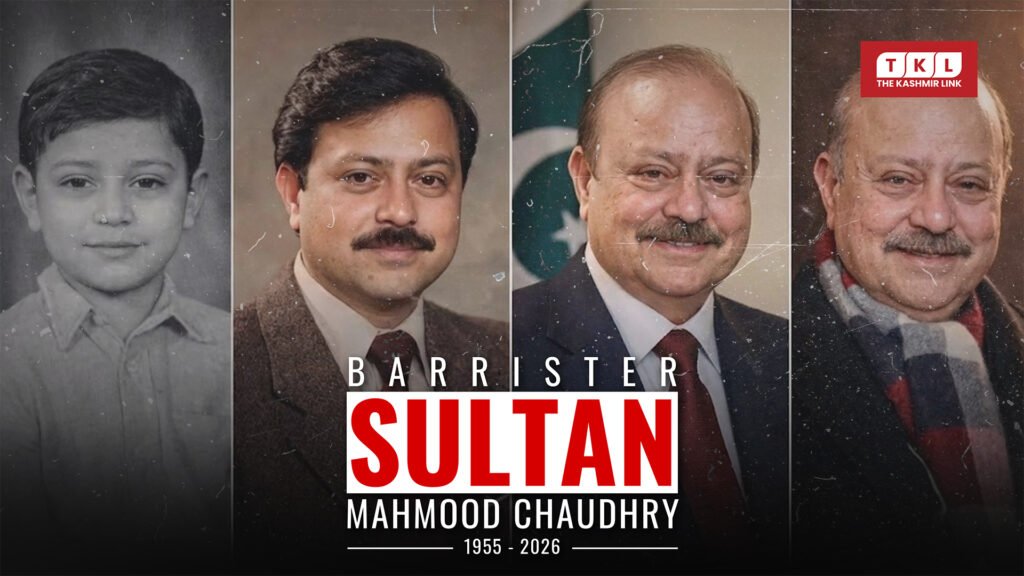
Barrister Sultan Mehmood – The day he left this world, it did not feel like the passing of a man.
It felt like the closing of a chapter.
Across Azad Kashmir, people wept quietly. Political rivals paused. Old companions remembered. An elderly voice trembled through tears:
“Today, my companion… my fellow traveler… has departed.”
Barrister Sultan Mahmood Chaudhary was not just a politician. For many, he was a voice — strong, relentless, and unafraid — raised again and again for Kashmir.
A Promise Made on a Stage
The story begins in the 1980s, at a charged political rally in Mirpur.
On the stage stood Chaudhary Noor Hussain, a towering political figure. Beside him was a young man, freshly returned from England. Holding his hand high, Noor Hussain declared in his thick Mirpuri accent:
“You say Noor Hussain is uneducated? Look — I have brought you a leader educated in Vilayat. From today onward, give him your vote.”
The crowd roared.
That moment was not simply a political endorsement.
It was a father passing the torch to a son — and a community placing its hopes in a new generation.
Born into the influential Jat community of Mirpur, Barrister Sultan entered politics at a time when Azad Kashmir’s power structures were deeply entrenched. Though the Jats were numerically strong, political dominance rested elsewhere. His father had a vision — to reshape that imbalance — and education was his weapon of choice.
England became the training ground.
The Young Barrister Who Chose a Different Courtroom
In London, he earned his Bar-at-Law. The courtroom awaited him.
But before arguing legal cases, he chose to argue a different one — the case of Kashmir.
In the 1980s, when the world’s attention rarely turned toward the valley, a young Barrister Sultan stood outside the Indian High Commission in London, leading protests. Placards were raised. Slogans echoed. The Mirpuri diaspora gathered behind him.
For him, Kashmir was not a slogan. It was a calling.
Newspapers began carrying his photographs. Television channels aired his speeches. At an age when many are still finding their voice, he had already found his cause.
He was no longer just a political heir.
He was becoming a political force.
The Return Home
In 1983, he returned to Azad Kashmir — not to practice law, but to practice politics.
He stepped into the arena with ambition in his eyes. He led his father’s party, navigated alliances, shifted platforms when needed, and demonstrated a sharp understanding of power dynamics.
From the Azad Muslim Conference to the Jammu Kashmir Liberation League, and later to the Pakistan Peoples Party (PPP), his journey was marked by strategic recalculations and bold decisions.
In 1996, that ambition reached its peak: he became Prime Minister of Azad Jammu and Kashmir.
For many supporters, it was a moment of pride. The young man introduced on that Mirpur stage had reached the highest executive office.
But politics is never a straight road.
Differences with Benazir Bhutto led to his departure from the PPP. He formed the Peoples Muslim League, hoping to carve an independent path. Yet the political winds were harsh. The new party struggled. Elections disappointed. In 2006, his political strength appeared at its weakest.
Many thought the story was ending.
They were wrong.
The Fighter Who Refused to Fade
When Tehreek-e-Insaf (PTI) emerged as a new political force, Barrister Sultan found another platform. In 2015, he joined PTI, and the welcome he received across Azad Kashmir was extraordinary.
At rallies, slogans for him thundered through the crowds. His personal following had not disappeared. It had endured.
Though the 2016 elections did not bring victory, he refused to retreat. Instead, he returned to what had always defined him: international advocacy for Kashmir.
From Britain to Europe to America, he raised the issue at every available forum. He spoke of UN resolutions. Of self-determination. Of a people waiting to decide their own future.
When PTI came to power in AJK in 2021, the premiership once again slipped from his grasp. Political rivalries intervened. Instead, he was appointed President of Azad Jammu and Kashmir.
The role carried less executive authority — but immense symbolic weight.
As President, he spoke of reconciliation. Of unity within constitutional limits. Of bringing divided political forces closer for the greater cause.
Time, however, is never entirely in our hands.
The Man Behind the Politics
Those who knew him describe him not as an ideologue, but as a realist — a strategist who understood when to advance and when to reposition.
He changed parties.
He rebuilt alliances.
He recalculated routes.
Critics called it pragmatism.
Supporters called it survival.
But on one matter, he never wavered: Kashmir.
From his youth to his final days, he spoke of the right of the Kashmiri people to decide their own destiny. Whether addressing diaspora communities or speaking from constitutional office, the cause remained at the center of his identity.
The Final Battle
In his later years, cancer began to weaken him physically. Yet politically, he remained present.
Even as illness tightened its grip, he continued engaging, speaking, representing.
He had served as Prime Minister.
As Leader of the Opposition.
And finally, as President.
When news of his passing spread, tributes poured in across party lines. Political opponents acknowledged his role. Colleagues remembered decades of companionship. Ordinary citizens mourned in their homes.
One elderly man, unable to hold back tears, whispered:
“Today, it feels as if Kashmir has been left without an heir.”
An Era That Will Be Remembered
Barrister Sultan Mahmood Chaudhary’s life was not free of controversy. It was not untouched by political maneuvering. It was not immune to setbacks.
But it was lived fully — in public service, in political struggle, and in unwavering advocacy for Kashmir.
His voice may have fallen silent.
His chair may now stand empty.
But for a generation of Azad Kashmiris, his name will forever echo with a time when politics was fierce, ambitions were bold, and the cause of Kashmir remained at the heart of every speech he delivered.
Some leaders leave office.
Some leave headlines.
A few leave an era behind.
Barrister Sultan Mahmood Chaudhary was one of them.


