
Are AJK’s 12 Refugee Seats ‘Contrary to Constitutional Scheme’?

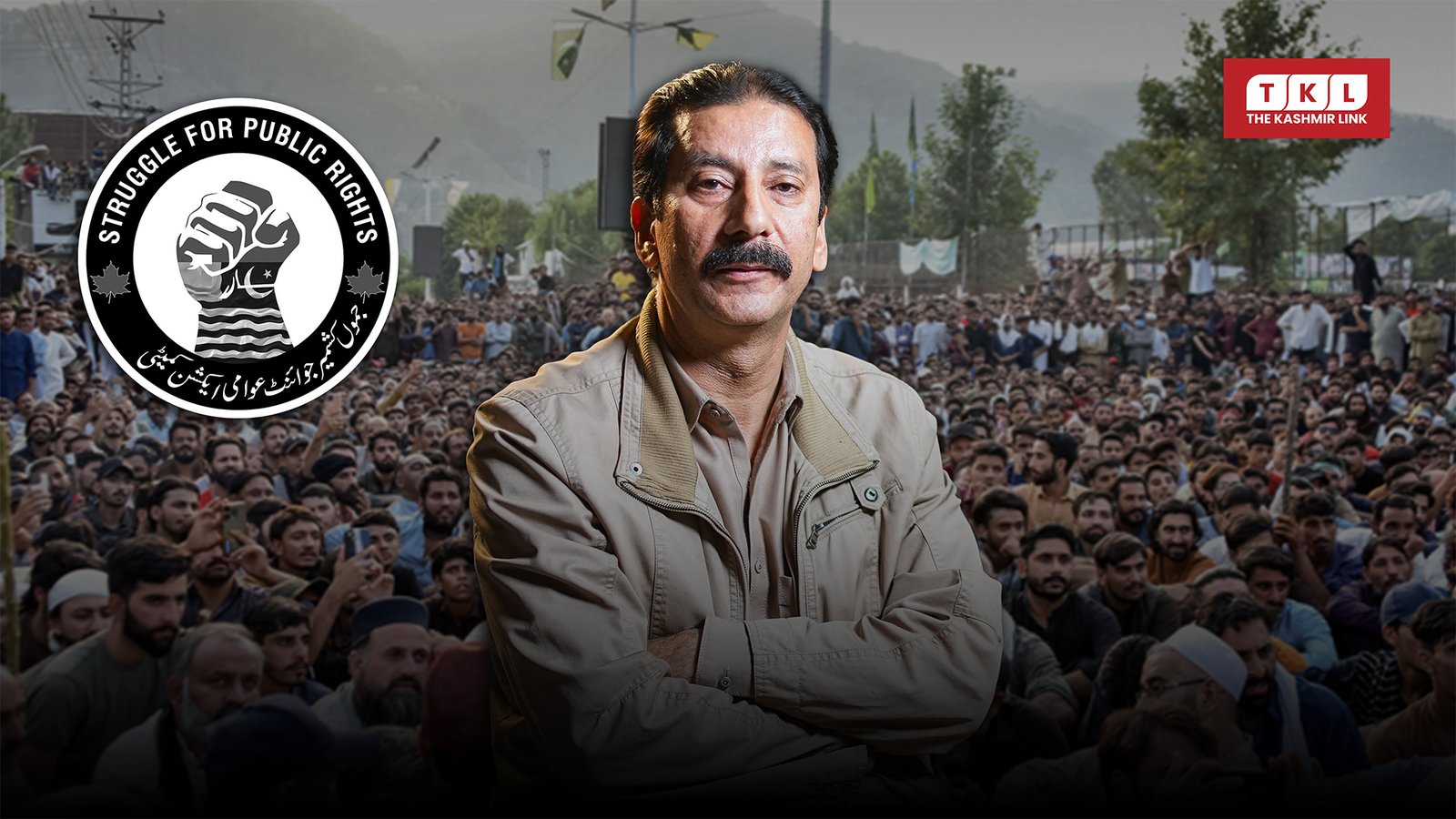
Constitutional Scheme – A detailed constitutional debate over the 12 assembly seats reserved for “refugees settled in Pakistan” in Azad Jammu and Kashmir (AJK) has resurfaced, following an in-depth interview with senior advocate and Joint Awami Action Committee (JAAC) core member Raja Amjad Ali Khan.
Presenting a layered legal, historical, and political argument, Khan maintained that opposition to these seats is not a recent development but has been part of a consistent stance since at least 2015—and, according to him, rooted even earlier in the formation of the Awami Action Committee itself.
Origins of the Debate: From Public Demands to Structural Critique
Khan explained that when the action committee was initially formed, its demands revolved around three core issues: flour prices, electricity, and the elimination of what he described as “illegitimate privileges of the elite.”
According to him, the 12 refugee seats became central to this debate as they were increasingly viewed by the public as a symbol of structural inequality. He argued that these seats contributed to the creation of what he termed an “alien elite,” which, in his view, operates in collaboration with power structures to exploit the resources of AJK.
He further claimed that over time, political practices have expanded these privileges, with a growing trend where elected members are elevated to ministerial positions, reinforcing concentration of power.
Legal Challenge and the 2015 Writ Petition
Khan highlighted that a formal legal challenge to these seats was mounted in 2015. The core argument of the petition was that the seats were not originally part of the constitutional framework but were instead created through the Election Ordinance of 1970.
The petition contended that reserving seats in the name of “refugees settled in Pakistan” conflicted with the scheme of the AJK Interim Constitution, particularly regarding representation and jurisdiction.
Although the High Court dismissed the petition on what Khan described as “technical grounds,” the Supreme Court later accepted its maintainability, admitted the case, and remanded it back to the High Court for a decision on merits.
However, before the case could reach a substantive conclusion, the 13th Amendment incorporated these seats into the constitution, effectively neutralizing the legal challenge. Khan argued that this move was intended to “cover” the constitutional inconsistency identified in the petition.
Questions Over Legitimacy and Representation
A significant portion of Khan’s argument focused on the legitimacy of representation associated with these seats.
Referring to recent claims made by refugee representatives, he cited allegations that tens of thousands of individuals listed as state subjects may not meet the legal criteria. He further stated that among the currently elected members on these reserved seats, some are allegedly non-state subjects, while others have disputed status.
Khan argued that this raises serious concerns about the integrity of the system, suggesting that the intended beneficiaries—original refugees and their descendants—are not the ones actually benefiting.
Jurisdictional Contradictions
A central legal argument presented in the interview relates to territorial jurisdiction. Khan emphasized that the authority of the AJK government, as defined in the Interim Constitution of 1974, is geographically limited—from Bhimber to Taobat.
He questioned how elections could be conducted outside this jurisdiction, arguing that individuals elected from outside the territory are legislating for residents within it without being subject to the same laws or taxation.
Invoking the principle of “no taxation without representation,” he described the arrangement as inherently contradictory, where those unaffected by local laws participate in shaping them.
Karachi Agreement and Division of Powers
Khan also pointed to the Karachi Agreement, under which key subjects—including defense, foreign affairs, and the rehabilitation of refugees settled in Pakistan—were assigned to the Government of Pakistan.
He argued that since these subjects fall outside the jurisdiction of the AJK Assembly, reserving seats in the assembly on their basis lacks constitutional justification. In his view, the arrangement creates duplication without authority.
Inequality in Representation
Another critical issue raised was the disparity in voter representation. Khan noted that constituencies within AJK often consist of tens of thousands of voters, while some refugee constituencies reportedly elect representatives with significantly smaller voter bases.
He argued that this imbalance undermines the principle of equal representation and raises questions about fairness within the electoral system.
Justice vs Identity: Reframing the Debate
Khan emphasized that the issue should not be viewed through the lens of “refugee versus local,” but rather through the broader principle of justice.
He pointed out that individuals categorized as “refugees settled in Pakistan” already enjoy full citizenship rights in Pakistan, including access to education, employment, and political participation. In contrast, residents within AJK face limited opportunities.
According to him, providing additional representation in AJK to individuals residing outside the territory effectively disadvantages local populations.
UN Resolutions and the Kashmir Dispute
Addressing concerns that altering the status of these seats could impact the Kashmir dispute, Khan rejected this notion.
He referred to United Nations Security Council resolutions from 1948, 1949, and 1950, which clarify that interim administrative arrangements in both Indian- and Pakistani-administered regions do not affect the final resolution of the dispute.
He argued that even significant constitutional changes on the Indian side have not altered the international legal framework, and therefore, similar adjustments in AJK would not have such an impact.
State Subject Law and Internal Rights
Khan also discussed the State Subject Law, noting that it allows individuals who move outside the state to retain their status for a limited period.
However, he emphasized that internal rights—such as access to resources and representation—are generally tied to residency within the state. He argued that extending these rights indefinitely to individuals living outside the territory contradicts the underlying principles of the law.
Call for Reassessment
Summing up his position, Khan stated that the issue is fundamentally about constitutional integrity and justice.
He argued that the existence of the 12 refugee seats lacks legal justification within the current framework and that their continuation contributes to systemic inequality. In his view, any arrangement that is inherently flawed is likely to be increasingly misused over time.
The interview has reignited debate across political and legal circles in AJK, with growing calls for a thorough reassessment of representation, governance structures, and constitutional principles in the region.


