




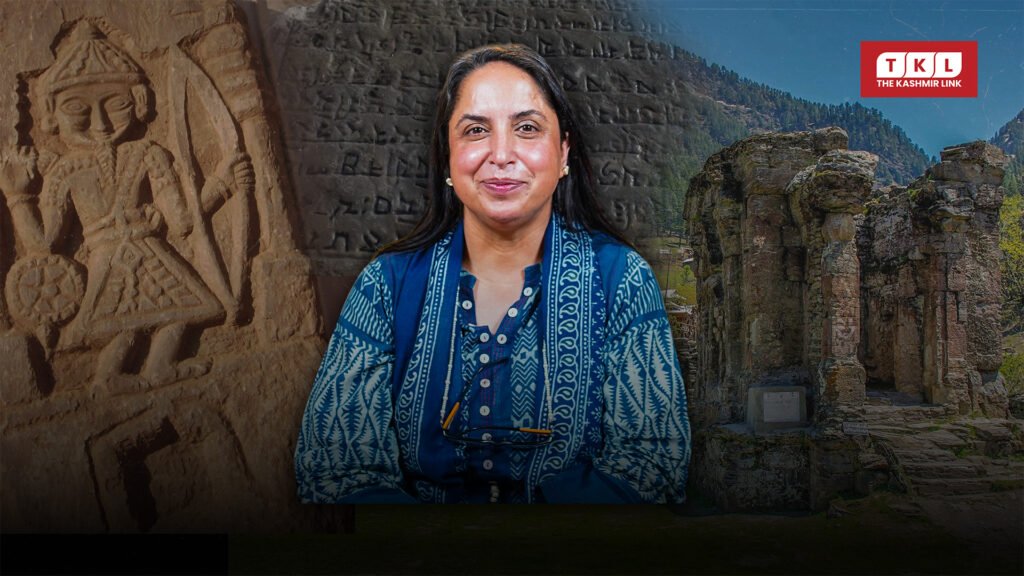
Sharda Civilization – For centuries, Kashmir has remained a land of mystery, culture, spirituality, and learning. Yet beneath its mountains, valleys, temples, and ancient routes lies a far older story — one that stretches back thousands of years into prehistory.
In an exclusive interview, renowned historian, archaeologist, fine artist, and academic Dr. Rukhsana Said Khan shared groundbreaking insights into the archaeology, cultural heritage, and historical identity of Kashmir and Azad Jammu & Kashmir (AJK).
Currently serving as Chairperson and Professor at the University of Azad Jammu and Kashmir, Dr. Rukhsana also heads the Sharda Center of Learning, an institution dedicated to preserving and researching the region’s archaeological and cultural heritage.
“Sharda Was the Earliest Script of Kashmir”
Speaking about the origins of Kashmir’s civilizational identity, Dr. Rukhsana emphasized the importance of the Sharda script and Sharda Peeth.
“Kashmir is counted among those civilizations whose initial script was Sharda, and its hub was Neelum Valley.”
She explained that Sharda Peeth was not only a religious site but also an ancient center of learning that represented the intellectual and cultural identity of Kashmir.
According to her, the establishment of the Sharda Center of Learning at the University of AJK was intended to revive and highlight this historical identity.
Languages as Living Cultural Heritage
Dr. Rukhsana described language itself as one of the most important forms of intangible cultural heritage in Kashmir.
She pointed toward the continuity of ancient civilizations through languages such as Kashmiri, Gojri, Shina, Balti Shina, and Pahari.
“The largest segment of our cultural heritage is language itself.”
She explained that these languages reflect the movement of civilizations and communities that passed through or settled in Kashmir over centuries, carrying influences from Buddhism, Hinduism, Gandhara, and Central Asia.
Discoveries Dating Back to the Fourth Millennium BCE
One of the most remarkable aspects of Dr. Rukhsana’s work is the archaeological chronology she developed for Azad Jammu & Kashmir through field surveys and excavations.
In collaboration with experts from the Taxila Institute of Asian Civilizations at Quaid-i-Azam University, she initiated archaeological explorations in 2011 that uncovered evidence dating back to the fourth millennium BCE.
“Recently, through excavations, we have authenticated that the history of Kashmir dates back to the fourth millennium BCE.”
Among the most significant discoveries were prehistoric tools found in Neelum Valley, connecting the region with Tibet and surrounding Himalayan civilizations.
These findings included:
- Prehistoric stone tools
- Rock inscriptions
- Rock-cut caves
- Ancient temples
- Epigraphical records
- Megalithic remains
- Ancient routes and sanctuaries
Sharda Temple and Evidence of Buddhist Influence
Excavations around the Sharda archaeological site revealed important artifacts including clay pipes, bricks, and copper coins.
Among the most important discoveries was a Kushan coin.
“The most significant was a Kushan coin, which tells us that the Kushan rulers had influence in this region.”
According to Dr. Rukhsana, the material unearthed around the present-day Sharda site strongly suggests that the location once functioned as a Buddhist monastery before later transformations into temple structures.
She explained that Kashmir’s history is layered, where different rulers and religious traditions often reshaped earlier sacred spaces according to their own beliefs.
Kashmir as a Crossroads of Civilizations
Dr. Rukhsana repeatedly emphasized that Kashmir cannot be studied in isolation.
She described the region as a historic crossroads connecting Central Asia, Tibet, Taxila, Gilgit-Baltistan, Hazara, and the wider Silk Route network.
“Kashmir also absorbed the movement of the Silk Road and the crossroads connected with it.”
Ancient monks, traders, travelers, and rulers passed through these routes for centuries. Historical records from Chinese monk Hiuen Tsang, Greek historians, and Rajatarangini all point toward Kashmir’s strategic and cultural importance.
She explained that ancient routes connected:
- Taxila to Srinagar
- Hazara to Muzaffarabad
- Neelum Valley to Gilgit-Baltistan
- Central Asia to Kashmir through Minimarg and Shounter
Alexander the Great and Ancient Kashmir
One fascinating part of the interview focused on archaeological and literary evidence connected with Alexander the Great.
Dr. Rukhsana discussed sites such as Mandhol Temple and Chittra Pari Rock Inscription, which she believes reflect cultural traces connected with Alexander’s era and the influence of his successors.
“We came to know that these events are reflected in Chittra Pari, Mandhol, and other places.”
She referenced historical accounts describing local chiefdoms submitting to Alexander near Taxila in 326 BCE, suggesting that these ancient routes were already active and interconnected during that period.
Archaeology Through Community Engagement
Unlike conventional archaeological approaches, Dr. Rukhsana’s research heavily involved local communities.
She described how she would travel door to door asking residents to show ancient objects discovered during house construction or farming activities.
“I would go door to door and tell people that if they had any old objects, I would not take them away, but I simply wanted permission to photograph them.”
This method allowed her to document sculptures, pottery, inscriptions, figurines, and artifacts preserved inside homes across AJK.
The collected materials were later analyzed with the assistance of experts and laboratories, including internationally renowned archaeologist Professor Mark Kenoyer.
CPEC and the Revival of Ancient Routes
Dr. Rukhsana also connected modern infrastructure projects with historical trade routes.
She argued that the China-Pakistan Economic Corridor (CPEC) represents a revival of pathways historically used by monks, traders, and travelers.
“When CPEC began in this region, it carried a very important narrative.”
She highlighted how the Chinese Prime Minister, during his parliamentary address in Pakistan, referred to the revival of ancient Silk Route pathways once traveled by Buddhist monks and merchants.
Ongoing Research with Tibetan Universities
Dr. Rukhsana revealed that her recent collaborative work with Tibetan universities has further strengthened the connection between prehistoric Kashmir and Himalayan civilizations.
She stated that scholars authenticated similarities between prehistoric tools discovered in Neelum Valley and those found on the Tibetan side.
“These routes, particularly those through Neelum Valley, are nearly four thousand years old.”
According to her, many archaeological locations in AJK still remain unexplored and hold immense historical potential.
Preserving Kashmir’s Civilizational Identity
Throughout the interview, one central idea remained clear: Kashmir’s identity is deeply rooted in a long, layered, and interconnected civilization.
From prehistoric settlements and Buddhist monasteries to Sharda script, Silk Route exchanges, Mughal pathways, and modern-day research collaborations, the region represents one of South Asia’s most historically significant cultural landscapes.
Dr. Rukhsana Said Khan’s work continues to play a major role in documenting, preserving, and authenticating this forgotten heritage for future generations.


