




Muzaffarabad:
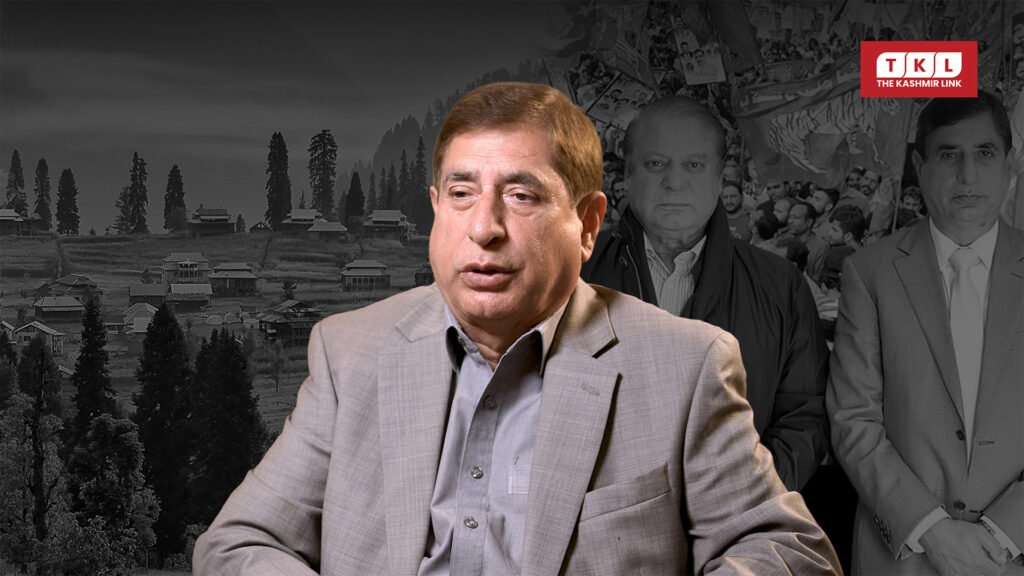
Opposition Leader in the Azad Jammu and Kashmir (AJK) Legislative Assembly and President of Pakistan Muslim League–Nawaz (PML-N) AJK, Shah Ghulam Qadir, says the political order that emerged after the 2021 elections has collapsed, leaving Azad Kashmir in a state of prolonged instability and making early, impartial elections unavoidable.
From Imposed Rule to Political Breakdown
Qadir traced the current turmoil to what he termed the “imposition” of Pakistan Tehreek-e-Insaf (PTI) in the 2021 AJK elections. “When something is imposed, it does not last,” he said, recalling how PTI’s first prime minister, Qayyum Niazi, was removed by his own party amid allegations of corruption and incompetence.
His successor, Sardar Tanveer Ilyas, fared no better. According to Qadir, Muzaffarabad was neglected while the prime minister remained largely in Islamabad, deepening administrative paralysis and internal party divisions.
The Forward Bloc and a Broken Coalition
The court-ordered removal of Tanveer Ilyas led to the emergence of a PTI forward bloc of around 25 members. With the support of PML-N and the Pakistan Peoples Party (PPP), Anwar-ul-Haq was elected prime minister under what was understood to be a coalition arrangement.
However, Qadir said the political balance shifted abruptly when Anwar-ul-Haq declared it a “government of MLAs” rather than of political parties. “That single statement changed the entire political dynamic,” he noted, effectively sidelining coalition partners and pushing their workers into opposition across most constituencies.
Governance Without Consultation
Qadir criticised the former prime minister for failing to consult coalition partners on political affairs, appointments or policy decisions. He said the lack of coordination made governance unworkable and eroded trust between parties.
He cited the failure to appoint a new Chief Election Commissioner before the incumbent’s retirement on January 14, 2025, as a major constitutional lapse. Despite raising the issue repeatedly in the Assembly and formally writing to the Chairman of the Kashmir Council, Qadir said no action was taken.
Action Committee and Political Vacuum
According to Qadir, this vacuum contributed directly to the rise of the Joint Awami Action Committee. He argued that the method adopted to deal with the committee lacked political maturity, ultimately leading to the no-confidence motion against Anwar-ul-Haq.
He explained that under the AJK Constitution, a no-confidence motion simultaneously names an alternative Leader of the House, unlike Pakistan’s Constitution. “This structure ultimately benefited the People’s Party,” he said.
PPP Government and ‘Announcement Politics’
Assessing the performance of the current PPP-led government, Qadir expressed scepticism, describing it as driven more by tours and announcements than by fiscal reality.
He pointed to the prime minister’s declaration of Rs 15 billion in development projects for Neelum Valley within two days. “Our total development budget is around Rs 40–41 billion, half of which has already been spent,” he said, questioning how promises running into Rs 150 billion could be fulfilled.
Why Politicians Keep Switching Sides
On shifting political loyalties in AJK, Qadir remarked that those who abandoned Imran Khan and later Anwar-ul-Haq could have just as easily joined PML-N. “We chose not to seek power through defections,” he said, adding that it is now up to the People’s Party to explain what has changed on the ground.
Opposition Then and Now
Qadir maintained that PML-N has effectively remained in opposition since 2021, making the current situation largely unchanged for his party. “The real narrative is what we plan to do when we return to power,” he said, confirming that the party’s manifesto committee is finalising its programme.
Call for Early and Fair Elections
Describing the 2021 mandate as “irreparably fractured,” Qadir argued that no long-term planning is possible under the present setup. He called for elections at the earliest possible time, or at the very least on schedule, stressing that there is no constitutional provision to delay them.
“Azad Kashmir is a disputed region, and the eyes of the world are on it,” he said, warning against any political adventurism.
Confidence in 2025
Qadir expressed confidence that transparent, non-partisan elections in 2025 would return PML-N to power, citing increased media scrutiny and public awareness. He also dismissed speculation about internal rifts, reaffirming loyalty to the party’s central leadership, Nawaz Sharif and Shehbaz Sharif.
Development, Jobs and Political Culture
Outlining PML-N’s vision, Qadir highlighted unemployment, erosion of political tolerance and governance paralysis as key challenges. He said development must go hand in hand with job creation and warned against contradictory policies that cannot be implemented.
Neelum Valley: Tourism, Environment and Livelihoods
While defending tourism as a source of employment in Neelum Valley, Qadir acknowledged serious issues related to sanitation, cultural change and environmental degradation. He stressed that forest conservation would remain unrealistic without providing alternative energy sources to local communities and ending timber smuggling under official patronage.
Refugee Seats: A Constitutional Question
On the contentious issue of refugee seats in the AJK Assembly, Qadir reiterated PML-N’s principled opposition to their abolition. He warned that removing them would have profound constitutional, legal and symbolic consequences for the State of Jammu and Kashmir.
“This issue requires dialogue, logic and consensus—not slogans,” he said, adding that the matter is currently before a committee and should be resolved through consultation.
A Political Crossroads
Concluding his remarks, Shah Ghulam Qadir said Azad Kashmir stands at a critical political juncture. “Demanding is easy; governing is difficult,” he observed, insisting that only a fresh mandate, institutional respect and coherent policy-making can restore stability, dignity and development in Azad Kashmir.


