




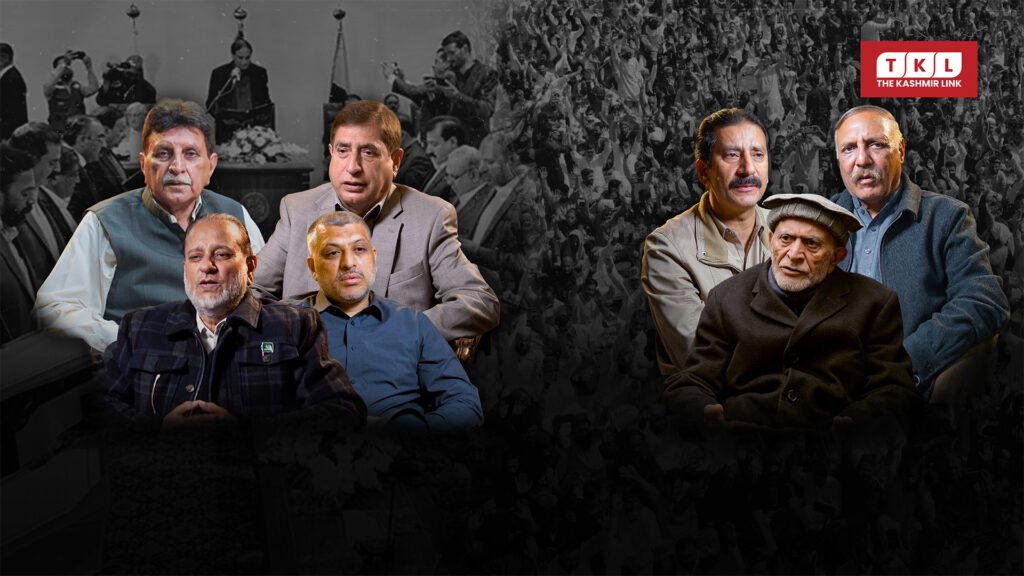
12 Refugee Seats – Few issues in Azad Jammu and Kashmir (AJK) generate as much political debate as the twelve legislative assembly seats reserved for Kashmiri refugees settled in Pakistan.
For supporters, these seats are a constitutional guarantee that preserves the connection between displaced Kashmiris and their homeland. For critics, they represent a system that enables political engineering, undermines merit, and distorts democratic representation.
Recent public discussions have brought together former prime ministers, constitutional experts, judges, refugee representatives and civil society activists, revealing a deep divide over the future of the seats.
The Historical Argument
Supporters argue that refugee representation has existed since the earliest political structures of Azad Kashmir.
MLA Ahmed Raza Qadri notes that many leaders of the first AJK government were themselves migrants, including Chaudhry Ghulam Abbas, Syed Nazir Hussain Shah and Khawaja Ghulam Din Wani.
Acting President AJK Choudhary Latif Akbar emphasized that the current system was built by historic leaders of the freedom movement.
“This system did not come just like that.”
According to supporters, refugee representation was deliberately created to preserve the political relationship between displaced Kashmiris and the State of Jammu and Kashmir.
The Constitutional Debate
However, critics argue that the arrangement conflicts with the constitutional framework of AJK.
Former Chief Justice of the Supreme Court of AJK, Justice Syed Manzoor Hussain Gillani, questioned the constitutional logic of elections being conducted outside the territory where the constitution applies.
“The jurisdiction of the Constitution extends to the territory of Azad Kashmir, whereas those elections are conducted extra-territorially.”
Gillani argued that AJK institutions possess limited authority over election administration in Pakistan’s provinces, creating a constitutional anomaly.
Critics point out that the seats originally emerged through election laws rather than constitutional provisions.
Former Prime Minister Raja Farooq Haider Khan acknowledged this historical reality.
“This seat was essentially a product of the 1970 election ordinance.”
However, he also defended his decision to provide constitutional protection to the seats during his tenure.
The Merit and Resource Question
For the Joint Awami Action Committee, the issue extends beyond constitutional theory.
Committee leader Shoukat Nawaz Mir argues that refugee quotas in educational institutions disadvantage students from within AJK.
“A child of our state who secures 90 percent marks is left behind, while others secure seats through the migrant quota.”
The committee also questions public expenditures linked to the twelve seats, arguing that substantial public resources are used to maintain a political structure that serves a limited number of elected representatives.
The Kashmir Issue Dimension
Supporters insist that the debate cannot be separated from the wider Kashmir dispute.
Former Prime Minister Sardar Attique Ahmed Khan argues that removing refugee representation would weaken Kashmir’s demographic and political case in any future settlement.
“The refugees are part of our constitution, part of the freedom movement, part of the sacrifices and part of Pakistan’s Kashmir policy.”
Ahmed Raza Qadri similarly warns that ending refugee representation could weaken the historical relationship between displaced Kashmiris and the state.
“The day you end the representation of the migrants, ask yourself this question: might you lose the justification for your own existence?”
Allegations of Political Engineering
Even among supporters of refugee representation, concerns exist regarding election practices.
Sardar Attique Ahmed Khan acknowledged criticism that ruling parties often gain an electoral advantage through refugee constituencies.
“Whoever is in government captures 8 to 10 seats from Punjab and starts with a lead.”
Likewise, Acting President Choudhary Latif Akbar stressed that elections must remain transparent.
“If the elections are non-transparent, then surely the demand of the people will keep gaining strength.”
Calls for Reform
Some participants proposed alternatives rather than abolition.
Justice Gillani suggested creating a comprehensive digital registry of Kashmiris worldwide based on verified state-subject records.
Others called for electoral reforms to eliminate alleged fake state-subject certificates and fraudulent voter registrations.
Even Ahmed Raza Qadri, a defender of refugee representation, stated:
“Fake votes must be eliminated.”
The Political Reality
For now, major political parties remain opposed to abolishing the refugee seats.
Opposition Leader Shah Ghulam Qadir stated clearly:
“We are not part of any campaign to abolish the refugee seats in Azad Kashmir.”
Yet public pressure continues to grow, particularly among sections of civil society who view the issue as central to broader governance reforms.
A Debate Far From Over
The controversy surrounding AJK’s twelve refugee seats ultimately reflects larger questions about democracy, representation, constitutional authority, identity, and the future of the Kashmir issue itself.
Whether the seats remain unchanged, undergo reform, or face future constitutional challenges, one thing is certain: the debate is no longer confined to political elites. It has become one of the defining constitutional conversations of contemporary Azad Kashmir.
And as the arguments from both sides demonstrate, neither side appears willing to back down.


