
AJK Council: Structure, Role and Powers

AJK Council – After the general elections, the formation of the government and the election of the President of Azad Jammu and Kashmir, another important electoral process is now underway in AJK.
The Azad Jammu and Kashmir Election Commission has announced the schedule for elections to four vacant seats of the Kashmir Council. Polling will be held on October 12, 2026, at the hall of the Azad Jammu and Kashmir Legislative Assembly in Muzaffarabad.
Political parties have also announced their candidates. According to sources, the Pakistan Muslim League-Nawaz (PML-N) has nominated Mushtaq Minhas, Chaudhry Muhammad Saeed and Chaudhry Manzoor, while the Pakistan Peoples Party (PPP) has nominated Chaudhry Latif Akbar.
But what exactly is the Kashmir Council? How are its members elected? What powers did it once possess, and what remains of its role after the Thirteenth Constitutional Amendment of 2018?
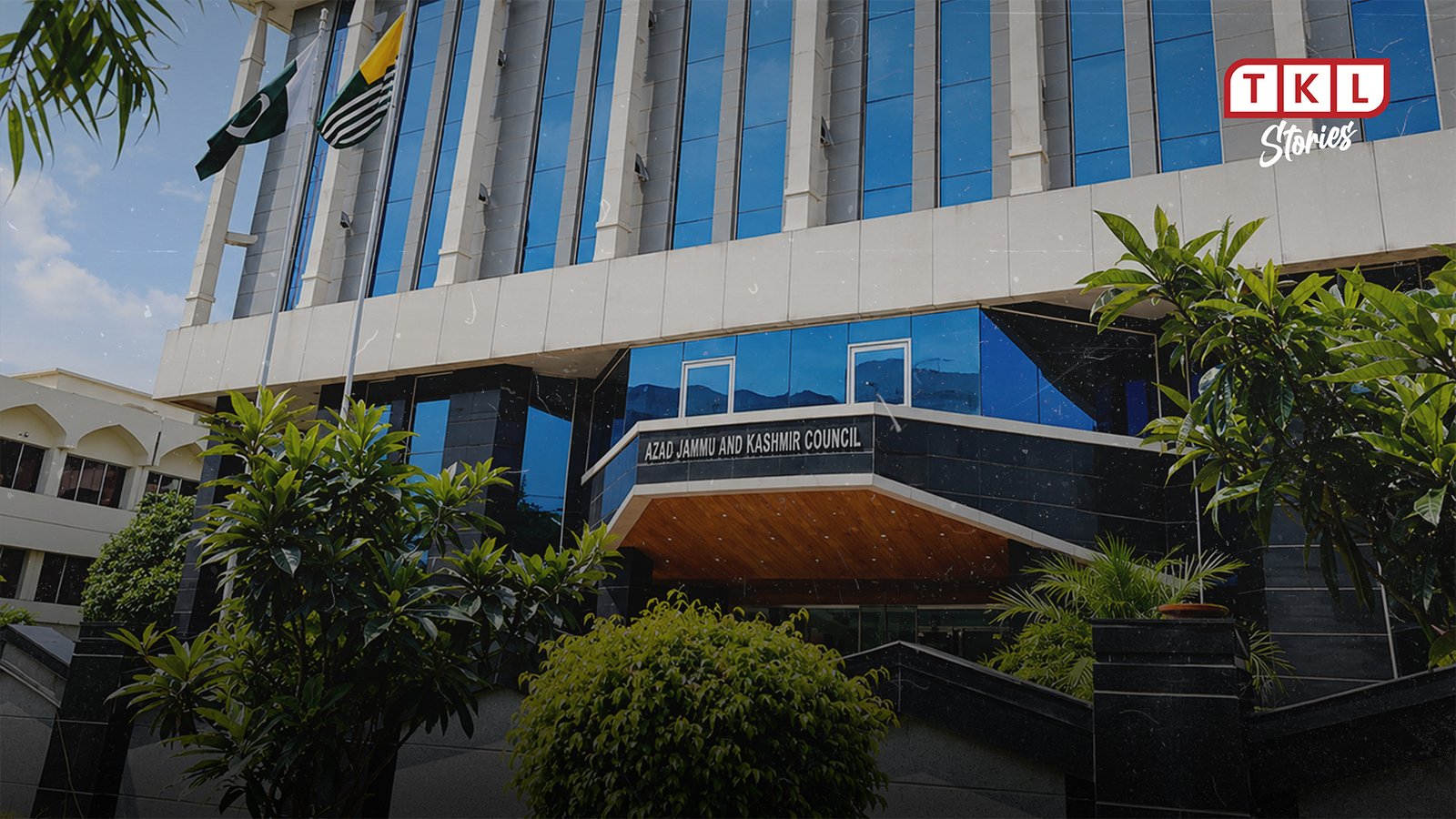
AJK Council – What is the Kashmir Council?
The Kashmir Council was established under the Interim Constitution Act of Azad Jammu and Kashmir, 1974.
It was created as a constitutional institution intended to provide a formal link between the governments of Pakistan and Azad Jammu and Kashmir.
The Council is headed by the Prime Minister of Pakistan, who serves as its Chairman, while the President of Azad Jammu and Kashmir serves as its Vice Chairman.
Its composition includes representation from both Pakistan and AJK. Five members are nominated by the Prime Minister of Pakistan from among federal ministers and members of Parliament.
The Prime Minister of AJK, or a person nominated by him, is also a member of the Council. In addition, six members are elected by the AJK Legislative Assembly.
The Federal Minister for Kashmir Affairs and Gilgit-Baltistan is also constitutionally associated with the Council.
Thus, under the constitutional framework, the Council has a total of 15 members.
However, the importance of the Kashmir Council historically stemmed not merely from its composition, but from the extensive powers assigned to it.
AJK Council – Why was the Kashmir Council so powerful?
When the 1974 constitutional arrangement was introduced, the Kashmir Council was given authority over a wide range of subjects.
Its powers extended to 52 matters, including important areas such as citizenship and migration, mineral resources connected with nuclear energy, banking, insurance and the stock exchange.
The Council also had significant administrative and financial responsibilities.
These included matters relating to inland revenue, the Office of the Accountant General and other administrative and financial affairs.
The Chairman of the Council also had a role in certain important constitutional appointments.
As a result, the Council became one of the most influential institutions in the governance structure of AJK.
Its extensive legislative, administrative and financial authority also became a subject of debate, particularly over the distribution of powers between Islamabad and the elected institutions of Azad Jammu and Kashmir.
AJK Council – What changed after the 13th Amendment?
A major change came in 2018, when the Thirteenth Constitutional Amendment fundamentally altered the role of the Kashmir Council.
The amendment abolished the Council’s former legislative, administrative and financial powers and transformed it largely into an advisory institution.
The constitutional distribution of powers was also revised.
Under the new arrangement, the AJK Legislative Assembly can legislate on matters that do not fall within Part-A of the Third Schedule of the Constitution.
The Government of Pakistan retains exclusive legislative authority over the matters included in Part-A.
There are also matters listed in Part-B, on which the AJK Assembly can legislate with the consent of the Government of Pakistan.
The Kashmir Council’s role, meanwhile, was substantially reduced to consultation and advice on matters falling within the relevant constitutional framework, including matters connected with the responsibilities of the Government of Pakistan under the resolutions of the United Nations Commission for India and Pakistan.
In simple terms, many of the powers that were previously exercised through the Kashmir Council were removed from the Council’s direct control and redistributed under the post-2018 constitutional arrangement.
Does the Council still have constitutional powers?
Although the Council’s former authority was significantly curtailed, it did not disappear from the constitutional structure altogether.
The Chairman of the Kashmir Council continues to have a role in certain constitutional appointments.
For example, the President of AJK appoints a judge of the High Court on the advice of the Chairman of the Kashmir Council. The Chairman also has a constitutional role in the appointment of the Chief Election Commissioner and the Auditor General of Azad Jammu and Kashmir.
Following the 2018 reforms, the Council’s assets, employees and related administrative responsibilities were transferred to the Government of Azad Jammu and Kashmir, while its previous separate financial structure was also abolished.
How are Kashmir Council members elected?
One important point is that a member of the Kashmir Council is not a member of the AJK Legislative Assembly.
The Council is a separate constitutional institution, and its elected seats are filled through a different electoral process.
The public does not directly vote for the six elected members of the Council.
Instead, the members of the AJK Legislative Assembly are the voters for these seats.
The election is conducted through proportional representation by means of the single transferable vote.
Voting is held through a secret ballot, with Assembly members indicating their preferences among the candidates.
A voter can mark 1 for the first preference, 2 for the second, 3 for the third and so on.
Therefore, the election is different from a conventional general election, in which a voter simply selects one candidate.
Through the preferential voting system, votes can be transferred according to the preferences marked on the ballot, allowing multiple seats to be filled through the same electoral process.
Can an Assembly member simultaneously become a Kashmir Council member?
No.
If a sitting member of the AJK Legislative Assembly is elected to the Kashmir Council, his or her Assembly seat becomes vacant.
In other words, a person cannot simultaneously continue as a member of the AJK Legislative Assembly and serve as an elected member of the Kashmir Council.
An elected member of the Kashmir Council has a five-year term. If that term expires before a successor assumes office, the outgoing member may continue until the new member takes charge, in accordance with the constitutional framework.
What does the October 12 election mean?
The October 12 election is therefore not a general election and does not involve direct voting by the people.
It is an indirect election conducted by the elected members of the AJK Legislative Assembly to fill four vacant seats in the restructured Kashmir Council.
The contest is taking place after a series of major political developments in AJK, including the general elections, formation of the new government and election of the President.
While the Kashmir Council no longer possesses the sweeping legislative, administrative and financial powers it held under the original 1974 arrangement, it remains a constitutionally recognised institution with a defined advisory and constitutional role.
The history of the Council also reflects the broader evolution of the constitutional relationship between Islamabad and Muzaffarabad.
From an institution with extensive powers in 1974 to a largely advisory body after the 2018 reforms, the Kashmir Council has undergone a significant transformation.


