




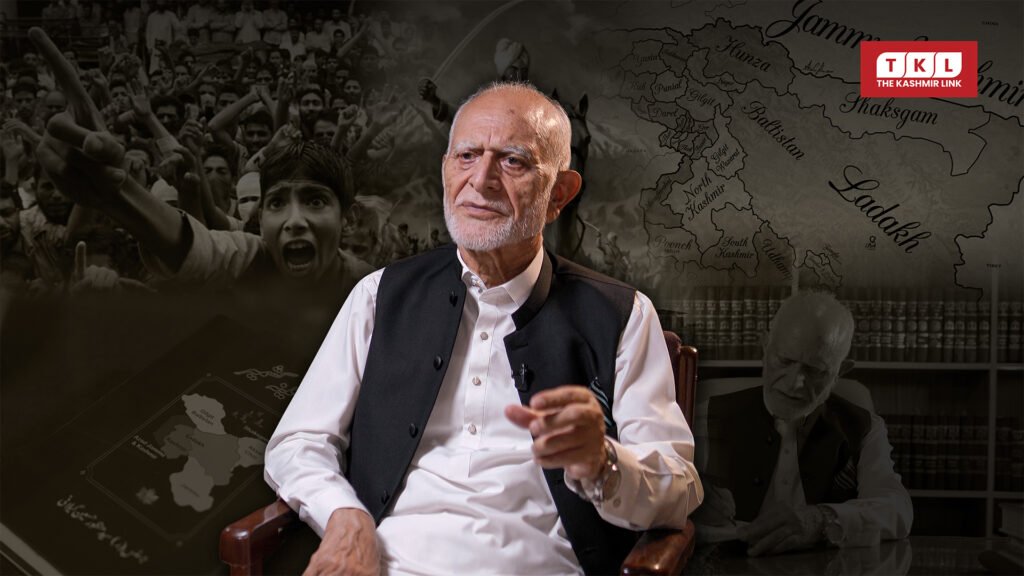
In Aaina-e-Kashmir, Justice Syed Manzoor Hussain Gillani offers a deeply researched, experience-rooted, and intellectually courageous re-examination of one of the world’s most prolonged and misunderstood conflicts — the Jammu & Kashmir dispute. Drawing from a lifetime of personal memory, political observation, legal expertise, and lived experiences on both sides of the Line of Control, Justice Gillani dismantles prevalent myths, questions long-held assumptions, and proposes an alternative path toward a dignified and realistic settlement.
The book is not merely a narration of events; it is an attempt to correct the conceptual foundations upon which public opinion, political narratives, and diplomatic approaches have been built for decades.
A Necessary Clarification: Kashmir Is Not Jammu & Kashmir
One of Gillani’s central contributions is his insistence on distinguishing between two terms often carelessly used interchangeably: Kashmir and Jammu & Kashmir. He argues that global discourse — and even domestic narratives — have steadily narrowed the meaning of “Kashmir” to the geographical Valley, thereby erasing the historical, political, and demographic significance of Jammu, Ladakh, Gilgit-Baltistan, and present-day Azad Kashmir.
This, he contends, is not merely a linguistic simplification but a conceptual distortion with real-world consequences. Whenever the conflict is framed as solely “Kashmir,” the other regions — with their distinct histories, cultures, and political conditions — silently disappear from the imagination of policymakers and the international community.
A Conflict Rooted in the Valley, Not the Entire State
Gillani places considerable emphasis on understanding that the freedom movement — from the Mughal era to modern times — has historically been concentrated in the Kashmir Valley, not uniformly across the entire state. Other regions resisted taxation, administration, or Dogra oppression at various times, but the anti-colonial freedom movement was uniquely Valley-centric.
This distinction, he argues, is vital. It clarifies why the Valley remains politically volatile while Jammu, Ladakh, Gilgit-Baltistan, and Azad Kashmir are comparatively settled within the frameworks of India or Pakistan. Without acknowledging this historical asymmetry, all talk of a “one-unit Kashmir” remains historically inaccurate and politically misleading.
Aaina-e-Kashmir – Twenty-Five Global Formulas — And Why None Have Succeeded
One of the book’s most valuable chapters surveys nearly 25 international formulas proposed over the decades — from the United Nations resolutions to scholarly think-tank proposals from Australia, Russia, and beyond. Gillani’s analysis is refreshingly pragmatic:
- The UN plebiscite formula was crafted for a very different time — 1947 — and repeatedly collapsed because neither party accepted it.
- The international community eventually stepped aside, concluding that Pakistan and India must decide the matter themselves.
- Other proposals, including those advocating division on religious or geographical lines, fail when tested against ground realities.
Gillani does not romanticize or idealize these formulas. Instead, he asks a simple, incisive question: Which solution relieves suffering without humiliating either nation and while honoring the will of the Kashmiri people?
Aaina-e-Kashmir – A Reinterpretation of Musharraf’s Formula
The most intriguing section of Aaina-e-Kashmir is Gillani’s reinterpretation of the Musharraf formula. He commends General Musharraf for proposing the most realistic framework since 1947 but believes it suffered from one fundamental flaw: its temporary nature.
Gillani argues for transforming it into a permanent geographical solution:
- Settle the already settled regions — Jammu and Ladakh with India, Azad Kashmir and Gilgit-Baltistan with Pakistan.
- Recognize governance across these settled regions, reducing cross-border hostility.
- Isolate the Kashmir Valley as the nucleus of the dispute, as only this region remains unsettled by consent.
- Grant the Valley an autonomous status, historically consistent with its pre-Mughal political identity.
- Then negotiate its long-term status with full involvement of its people.
His argument is built not on idealism but on demographic, political, and historical realities. In his view, every durable solution must acknowledge that the Valley’s aspirations are not mirrored across the entire state.
Aaina-e-Kashmir – Why a Plebiscite Is No Longer Meaningful
Perhaps the book’s most controversial position — articulated with clear evidence — is that a plebiscite is now neither practical nor meaningful.
Gillani points out that:
- The principle behind the 1947–48 UN resolutions no longer fits the demographic realities of 2025.
- India has settled nearly 4.5 million people in Jammu alone, fundamentally changing the voting landscape.
- Any future plebiscite would be structurally tilted in India’s favor.
- Pakistan would never accept such a plebiscite, nor should it, as Quaid-e-Azam rejected a similarly compromised proposal in 1947.
Gillani’s conclusion is blunt but rational: the plebiscite has expired as a viable mechanism, yet the conflict still demands a principled, peaceful solution.


