




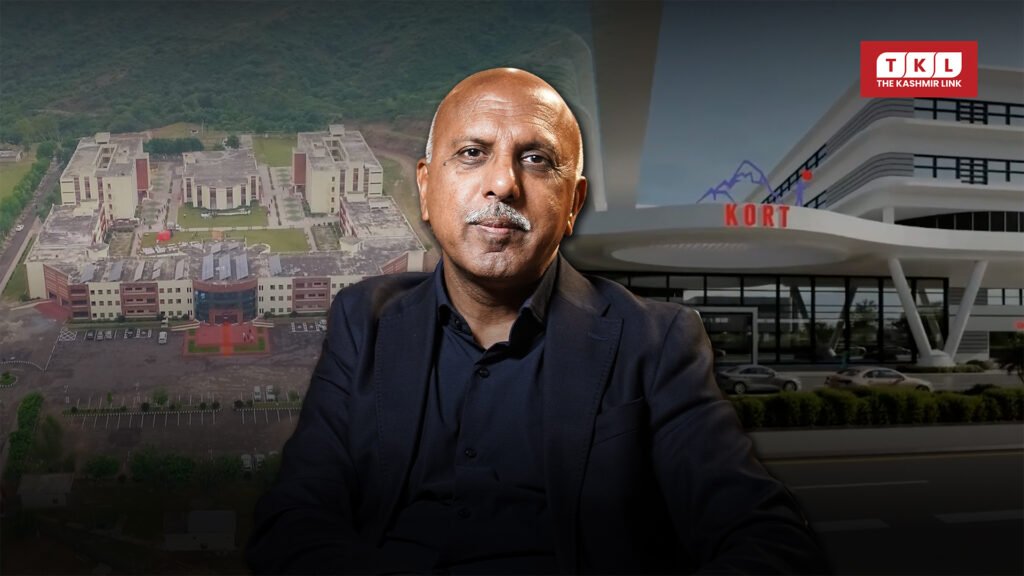
KORT – By the time Chaudhry Muhammad Akhtar finished speaking, it was clear that this was not a conversation about charity in the conventional sense. It was about obligation, restraint, and a belief that service, when performed quietly, carries greater weight.
“Call me wise or call me foolish—both are in my favor,” Mr. Akhtar said, smiling slightly. “I consider myself very fortunate. Very fortunate indeed.”
Mr. Akhtar, the chairman of the Kashmir Orphan Relief Trust (KORT), was born in England and spent most of his life there. He speaks Urdu fluently now, though he insists he never formally studied it. “I learned it from the children,” he said. “The orphan children taught me.”
His journey to Pakistan was not meant to be permanent. After the 2005 earthquake, one of the deadliest disasters in the country’s history, he arrived to assist with relief work, expecting to stay for a few weeks. What he encountered—particularly the condition of orphaned children—altered the course of his life.
“It started with a rented building,” he said. “And from there, Allah took the work forward—through the prayers of these children.”
Today, KORT operates across Azad Kashmir and Pakistan, working in orphan care, education, housing for widows, disaster relief, clean water provision, disability access and healthcare development. The organization has constructed hundreds of homes for families displaced by earthquakes and floods, including 250 houses in Balochistan after recent flooding and 150 homes after the 2019 Mirpur earthquake. Earlier projects followed the 2010 floods in Peshawar, where KORT built 171 houses.
Mr. Akhtar is careful not to frame this as exceptionalism.
“We do our work quietly,” he said. “We don’t beat drums. We show it to the One above.”
One of KORT’s lesser-known initiatives focuses on people with disabilities, particularly wheelchair users—an issue Mr. Akhtar understands personally. His wife, who passed away after a long illness, used a wheelchair for many years.
“The problem isn’t food or water,” he said. “The problem is dignity. Where does a person go when they need a washroom?”
KORT has installed wheelchair-accessible washrooms in public spaces across Islamabad, including F-9 Park, Daman-e-Koh, Shah Faisal Mosque and the Pakistan Monument. The organization has also distributed hundreds of wheelchairs—many manufactured by wheelchair users themselves at a small factory established by KORT in Lahore.
“We don’t give a wheelchair once,” Mr. Akhtar explained. “We give it for life. When it breaks, you call us. We replace it. As long as Allah gives you life.”
That policy emerged after an encounter that unsettled him. While distributing wheelchairs, he visited a man’s home and found two unused chairs already inside.
“He said, ‘I took them because I don’t know when I’ll get another one,’” Mr. Akhtar recalled. “That fear makes people take someone else’s right. We wanted to remove that fear.”
Much of KORT’s work centers on widows—particularly those without male guardians, who often face social and economic isolation.
“When a father’s shadow is gone, life becomes very difficult,” Mr. Akhtar said. “Relatives turn away. Sometimes they even take what is legally her right.”
KORT builds homes for widows on land they already own, covering the full construction cost. Each house includes two bedrooms, a kitchen, a bathroom and a veranda. Materials are often transported to remote mountain villages by mule or carried by hand.
“Logically, it doesn’t make sense,” Mr. Akhtar said. “But we are not building for logic. We are building for responsibility.”
The organization is now preparing for what may be its most ambitious undertaking: a hospital and nursing college in Azad Kashmir. A nursing school is expected to become operational within six months, with plans to train 250 to 300 nurses before the hospital opens.
“The strength of a hospital is not doctors,” Mr. Akhtar said. “It is nurses and paramedics. That is where we are starting.”
KORT currently employs nearly 300 staff members, almost all of them local. Mr. Akhtar insists on paying competitive salaries, a stance he believes is essential for institutional integrity.
“The English say, ‘If you pay peanuts, you get monkeys,’” he said. “If people are paid properly, they don’t need to compromise.”
Despite spending two decades in Pakistan, Mr. Akhtar rejects the idea that the country is defined by its failures.
“Yes, there is corruption,” he said. “But where is it not? I’ve seen beggars in London too.”
What he has witnessed instead, he said, is gradual progress—in education, infrastructure and public awareness. He believes the country’s greatest untapped resource is its youth.
“Talent like ours is nowhere else,” he said. “The only thing missing is opportunity.”
As the interview drew to a close, Mr. Akhtar returned to a theme he revisits often: restraint.
“People praise you, and that’s dangerous,” he said quietly. “Praise belongs to God. If arrogance enters, all this work is rejected.”
He paused, then added, “This work is an addiction. I pray Allah gives this addiction to everyone.”
For Mr. Akhtar, the past 20 years are not a chapter but a beginning.
“The life I have truly lived is these last twenty years,” he said. “And Insha’Allah, I will stay on this path until my last breath.”
More Interview blogs


