




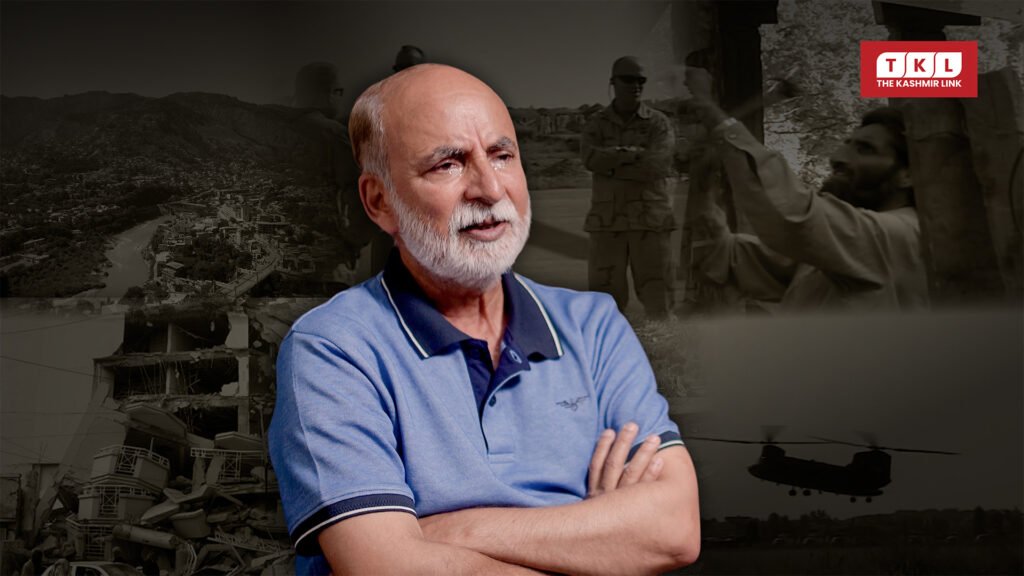
Rebuilding – “We are the people who have seen two Muzaffarabad — one before the night of October 7, and another after the morning of October 8.”
With these haunting words, Zahid Amin, former Chairman of the Development Authority Muzaffarabad (DAM), begins to recall the morning that changed everything for Kashmir.
It was ten minutes to nine on October 8, 2005, when the earth convulsed violently beneath Muzaffarabad. In those few terrifying seconds, homes crumbled, hillsides collapsed, and the familiar rhythm of life was replaced by a silence so deep that it still echoes two decades later.
The Morning the Earth Roared
“The streets were empty that morning,” Zahid recalls. “There were no motorcycles, no cars — just calm. And that was the last time we saw Muzaffarabad as it was.”
He remembers the first tremor — a deafening roar, a vibration so fierce it seemed to come from inside the earth. “An empty building doesn’t shake on its own,” he says. “That sound — it killed people before the stones even fell. They died from fear itself.”
Within moments, dust filled the air. Walls cracked open, windows burst outward, and people stumbled out of their collapsing homes in disbelief. “You couldn’t recognize faces because of the dust. Everything froze in front of my eyes,” he says.
He tells of a mother begging for help as her child’s leg hung by bone. A man — perhaps a dispenser or doctor — appeared and calmly bandaged the child’s wound before vanishing forever. “If he’s listening today, I want him to know — what courage he had.”
The First Responders and Foreign Rescuers
In the hours that followed, the people of Muzaffarabad became their own rescuers. With no trained emergency teams or equipment, locals used their bare hands to dig survivors from the rubble. “If you save someone in the first 24–48 hours, you save a life,” Zahid says. “But we had no system, no preparation. We didn’t even know we were living in a seismic zone.”
Help arrived from beyond. Pakistan’s Army mobilized rapidly, followed by NATO, British, Turkish, and Canadian rescue teams — many rerouted from Afghanistan. “They had machines that could detect life under the rubble,” Zahid remembers. “If they hadn’t come, our suffering would have lasted much longer.”
He credits the late General Pervez Musharraf’s leadership and the collaboration between Pakistani and foreign forces for saving thousands of lives. “That nation must never be forgotten,” he says. “Their cutters, their courage — that’s what pulled us back from the edge.”
The Human Spirit and National Response
From Mangla to Karachi, convoys of volunteers poured in. “Women came with their jewelry and cash,” Zahid says. “People from all over Punjab and Sindh drove to Muzaffarabad to help — sometimes without food, without sleep.”
He recalls how Rangers established posts across the city, even inside Madina Market, to prevent looting after October 10. “If they hadn’t done that, chaos would have followed,” he adds.
Rebuilding a City, Forgetting the Promise
Two decades later, Zahid’s tone shifts from memory to disappointment.
He points toward Chaudhry Anwar, a locality that still suffers from urban flooding every year. “There is no reconstruction work there. The Capital Development Package was supposed to fix it — the drainage system, the water flow — but nothing was done,” he laments.
According to Zahid, the Annual Development Programme (ADP) 2025–26 includes no urban reconstruction project and no development package for earthquake-affected areas. “This government has no idea how to address the growing suffering in the settler towns,” he says. “The Development Authority has two chief engineers who, in three years, have achieved not even zero percent of progress. They just write letters.”
He lists halted or neglected projects — drinking water schemes, hospital funding, urban drainage, and health facilities like AIMS and CMH. “For three years, they haven’t received a single penny. How will this system survive?” he asks.
Twenty Years Later: Are We Prepared?
Zahid’s voice grows solemn when asked about the future. “If another disaster happens — God forbid — what will we do? We’re in Seismic Zone IV, yet we have no preparedness, no training, no functional infrastructure.”
His question lingers painfully: Have we learned anything since 2005?
The tragedy that claimed over 87,000 lives and displaced millions taught Pakistan and Azad Kashmir the cost of unpreparedness. But today, Zahid warns, the lessons are fading. “Our reconstruction is incomplete, our systems are weak, and our leadership is asleep.”
A City Between Memory and Hope
Two decades after the quake, Muzaffarabad has risen from the dust — but only halfway. Behind its new buildings lie unhealed wounds and unfinished promises.
For Zahid Amin, remembering October 8 is not nostalgia; it’s a duty.
“We owe it to those who died, to those who rebuilt this city with their hands,” he says quietly. “But if we forget what happened — and what we failed to do after — then we betray them all.”


